Surgery for Ulcerative Colitis

Last full review: December 2025

Next review date: December 2028

Medicines are an important treatment for Ulcerative Colitis, but some people will choose or need to have surgery. Having surgery can feel like a big step. It can be a lot to deal with, both physically and emotionally. But you’re not alone.

We’re here to help you understand your options and make an informed choice about your care. This information looks at:

  • Why you might be offered surgery
  • The risks and benefits of surgery
  • The different types of surgery used to treat Ulcerative Colitis
  • What to expect when preparing for and after having surgery

Where we use ‘Colitis’ in this information, we are referring to Ulcerative Colitis. It is rare to need surgery for Microscopic Colitis. Crohn’s Colitis is also managed differently. If you are looking for information on Crohn’s Colitis, you may find our information on surgery for Crohn’s Disease helpful. 

This information might use words you have not heard before. Our page on medical words can help provide an explanation.

Download this information (PDF)

More Information

    • You may be offered surgery if medicines are not controlling your symptoms, or if you develop severe complications. Surgery might also be offered if you have cancer or pre-cancerous changes.
    • Fewer people with Colitis now need surgery compared to 20 years ago. Around 7 in 100 people with Colitis will need major surgery in the first five years after diagnosis.
    • Some people choose to have surgery. You can ask about whether surgery is an option for you, even if your IBD team have not mentioned it.
    • Surgery is an effective treatment option for many people. Most people who have surgery say they would have the same procedure again.
    • Colitis cannot come back if all the large bowel and rectum have been removed. However, some people still have symptoms outside of the gut, such as in their joints or eyes.
    • Many of the common surgeries for Colitis can be done by keyhole surgery, also called laparoscopic surgery. There are many benefits to this type of surgery, including a faster recovery.
    • Common types of surgery for people with Colitis include subtotal colectomy with ileostomy, and J pouch surgery. Both of these surgeries offer a similar quality of life.
    • Having surgery can bring emotional as well as physical challenges. It might also feel difficult to make a choice about which treatment is best for you. Your IBD team and Crohn’s & Colitis UK can help provide support.
    • The gut is the part of your body that takes food and nutrients in and carries poo out.
    • The bowel is the largest part of the gut and is made up of the small bowel and large bowel.
    • The term ‘colitis’ by itself is a general term that means inflammation in the colon. The colon is part of the large bowel.
    • There are different types of colitis. Ulcerative Colitis is a type of Inflammatory Bowel Disease, which causes painful ulcers and inflammation.

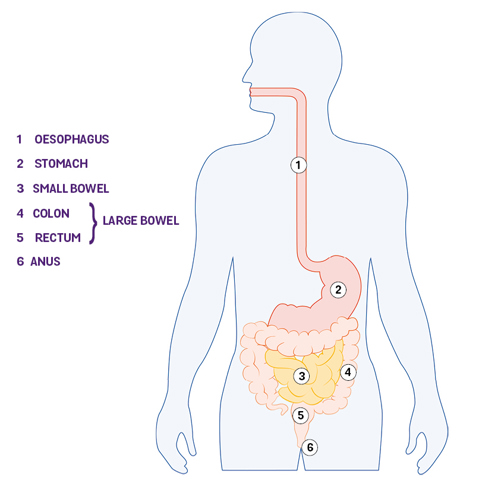
    The gut starts at your mouth, when you eat, and ends at your bottom or anus, where poo passes out of your body.

    digestion graphic

    The bowel

    The bowel is the largest part of the gut and is made up of two sections. These are the small bowel and the large bowel. The large bowel starts at the beginning of the colon and ends at the hole in your bottom, known as the anus. It includes the colon and rectum.

    The small bowel helps to break down food and take in nutrients. The large bowel takes in water and removes waste products from our body. As water is absorbed, the broken-down food turns into solid poo. When the bowel is healthy, the poo drops into the rectum, and you feel the urge to go to the toilet. The poo then passes out through the anus.

    How Ulcerative Colitis affects the gut

    Ulcerative Colitis is an Inflammatory Bowel Disease, or IBD, where problems with your immune system cause inflammation in the gut.

    Ulcerative Colitis causes painful ulcers and inflammation in the large bowel. This inflammation can cause watery poo or diarrhoea and tummy pain. You may need to poo more often and reach the toilet quickly. There may be blood and mucus in your poo. You may also feel extreme tiredness, known as fatigue.

    You can find out more about symptoms of Ulcerative Colitis in our information on Ulcerative Colitis.

    Types of Ulcerative Colitis

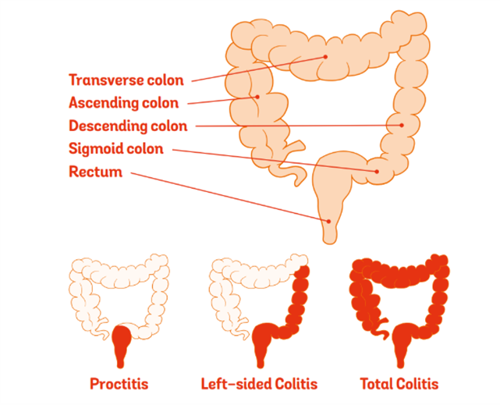
    The type of Ulcerative Colitis you may have is based on how much of your large bowel is affected. This can affect the symptoms you experience and the treatment you’re offered.  The main types are:

    • Proctitis. This is where inflammation affects the rectum only.
    • Left-sided Colitis, also called distal Colitis. This is when inflammation affects the rectum and the left side of the colon only.
    • Total Colitis, also called pancolitis or extensive Colitis. This is where inflammation affects all of the colon and rectum.

    We refer to Ulcerative Colitis as ‘Colitis’ in this information. The term ‘colitis’ by itself is a general term that means inflammation in the colon. There are different types of colitis. Some are not types of Inflammatory Bowel Diseases and are different to Ulcerative Colitis. Other types of colitis include:

    • Microscopic Colitis.
    • Crohn’s colitis – this is Crohn’s Disease in the colon. See our information on Crohn’s Disease.
    • Ischaemic colitis.
    • Radiation or immunotherapy colitis.
    • Diversion colitis.
    • Infectious colitis.
  • Fewer people with Colitis now need surgery compared to  20 years ago. There are many possible reasons for this, such as increasing use of biologic medicines and new tests, which can help with earlier diagnosis.

    Recent studies show that:

    • Around 7 in 100 people with Colitis will need major surgery to remove their colon in the first five years after diagnosis.
    • Around 10 in 100 will need major surgery in 10 years after diagnosis.

    Your individual risk of needing surgery at some point will depend on many things.

    Finding out you need surgery can be a lot to process. But do not forget, we are here to support you.

    “”

    Although my first surgery was an emergency and decided for me, the decision to have an internal pouch gave me my life back from Colitis symptoms and I would make the same choice again. Yes, it was painful in recovery but since then I have never looked back. My dad and brother both have Colitis (although neither have had surgery) and I am grateful that I no longer experience the flares and painful symptoms that they still do on occasion.

    • Many people think surgery is the last option, but that is not true. Surgery is offered when doctors think it will help your symptoms. You can also choose to have surgery.
    • Some people may be offered both medicines and surgery. See our information on treatments to find out more about medicines for Colitis.

    There are several reasons you may be offered surgery.

    Your choice

    You may be given the option to continue taking medicines or to have surgery. Some people choose to have surgery rather than manage the unpleasant side effects of medicines.

    You can ask about whether surgery is an option for you, even if your IBD team have not mentioned it. Our appointment guide contains a list of questions you might want to ask.

    If medicines are not working for you

    If medicines are not suitable or are not working well for you, your doctor may suggest surgery to help control your symptoms.

    Slow growth in children and teenagers

    For children and teenagers, being poorly and unable to get enough nutrients from food can affect their growth and development. Taking steroids can slow growth even further. Most children and teenagers with Colitis will be treated with medicines. But sometimes surgery may be needed to help with growth or development.

    Higher risk of bowel cancer

    Colitis is not cancer, but it can increase the risk of colon and rectal cancers.  The overall risk is low.

    The risk of developing bowel cancer increases around 8 years after the start of Colitis symptoms. Your risk of cancer is highest if all, or most, of your colon is affected by Colitis. This is known as extensive Colitis, total Colitis or pancolitis. If you are at higher risk of developing bowel cancer, you will be offered more regular colonoscopies. A colonoscopy is a camera test to look closely at the lining of your bowel. Colonoscopies can help to spot pre-cancerous changes in the bowel. If changes are found, you may need surgery. See our information on bowel cancer risk.

    Acute Severe Ulcerative Colitis (ASUC)

    ASUC is a serious medical emergency that requires a stay in hospital for treatment and monitoring. ASUC is usually treated with steroids, but for around 1 in 3 people this does not work. If steroids do not work, you may be offered other medicines. But, if your condition is very severe, surgery may be the safest option.

    Sometimes ASUC can cause complications that may need emergency surgery. These complications include:

    • Toxic megacolon. This is where the colon becomes severely inflamed and enlarged and is at risk of tearing.
    • A hole or tear in the gut. This is called a perforation.
    • Severe bleeding from the gut.
    • Surgery can help reduce gut symptoms of Colitis that are difficult to manage.
    • Getting used to a stoma or a pouch will take time. For some people, it can be a challenge.
    • Colitis cannot come back if all of the large bowel has been removed. The large bowel includes the colon and the rectum. However, some people still have symptoms outside of the gut, such as in their joints or eyes.

    Surgery can help reduce gut symptoms of Colitis that are difficult to manage. Improving your symptoms may mean you can do other things more easily. For example, seeing friends and family, going to work, or playing sports. It may mean you need to take fewer medicines and can avoid the side effects of many medicines. Surgery could give you more freedom to do what you want to do in life.

    “”

    My surgery was an emergency at the age of 37…After the surgery I kept thinking any minute I’m going to look down at my ileostomy and totally freak out but I didn’t. I don’t know why, maybe because I knew that finally I was going to get better and because I had the support of a loving family and children to look after. I had pouch surgery 18 months later and really have never looked back. I eat whatever I like, I exercise regularly and Colitis is now a distant memory.

    Getting used to a stoma or a pouch will take time, and it can be a challenge. For some people, life after pouch surgery can still mean going to the toilet frequently. This can be six or more times a day, including two or more times overnight. However, most people report a good quality of life after pouch surgery. And most people say that they would have the same surgery again.

    Let your surgical team know what is important to you. They can talk to you about how surgery may impact that. This might include improvements you can expect, or lifestyle changes you will need to make. This can help you make a decision that is right for you.

    Colitis coming back after surgery

    Colitis cannot come back if all of the large bowel has been removed. The large bowel includes the colon and the rectum. However, some people still have symptoms outside of the gut, such as in their joints or eyes.

    For most people, removing all the large bowel should mean:

    • Relief from tummy pain
    • Lessening of symptoms such as urgency and diarrhoea
    • Being able to stop taking medicines that may be causing side effects
    • No risk of bowel cancer

    There is very little research into fatigue after surgery. And from the research that exists, it is not yet clear what impact surgery has on fatigue.

  • Your treatment options will depend on you and the severity of your Colitis. Medicines do not work for everyone, and some complications of Colitis can be life-threatening without surgery. Speak to your IBD team and decide together which treatment options are best for you.

    • Colitis is different for everyone, and the risks and benefits of each treatment will vary from person to person.
    • Your surgical team should go through your individual risk with you. They should tell you how to lower your risk of complications. For example, if you smoke, stopping smoking can help to lower your risk.
    • It’s important to know what your risks are so you can make an informed decision about your treatment.
    • Do not be afraid to ask your surgical team about your risks. See our appointments guide for tips on getting the most from your appointments.

    During surgery

    Having any type of surgery will carry some risks. These include a risk of infection and risks linked to having a general anaesthetic, such as having an allergic reaction to the anaesthetic.

    If you live with other conditions like diabetes or high blood pressure, your chance of complications may be higher. Ask your surgical team how this would affect your risk of complications.

    After surgery

    Blood clots

    There is a risk of developing blood clots soon after surgery. And this risk is higher in people with Colitis. Your surgical team will assess your risk of blood clots before you have surgery and will put measures in place to lower this risk.

    Anastomotic leak

    An anastomosis is when two bits of bowel are joined together. Sometimes they may not join properly, and this can lead to a leak. Your surgical team can tell you more about anastomotic leaks, how common they are, and how they are usually treated.

    Bowel obstruction

    Having surgery can increase the risk of scar tissue forming inside your tummy area, known as your abdomen. This scar tissue can cause blockages or obstructions in your bowel. Your surgical team can tell you more about bowel obstruction, how common it is, and how they are usually treated.

    Post operative ileus

    Having surgery can temporarily disrupt movement of the bowel. This stops the normal movement of food, liquid and gas through the gut. Post operative ileus can happen after any surgery. But it is more common after abdominal surgery.

    Inflammation in the rectum

    If you have surgery that does not remove your rectum, you could still get inflammation in your rectum. This can happen due to:

    • Ulcerative Colitis. Ulcerative Colitis can affect all the large bowel. So, if your rectum is not removed, Ulcerative Colitis can affect this area. Medicines such as 5-ASAs or rectal steroids may be able to help control this inflammation.
    •  Diversion proctocolitis. Diversion proctocolitis can happen after stoma surgery. It is when the colon or rectum that poo no longer passes through gets inflamed. It is quite common, and most people do not have symptoms. If you do get symptoms, they can include pain and bleeding from the bottom. For some people, these symptoms can be quite bad. It is often difficult to tell the difference between Ulcerative Colitis affecting the colon or rectum and diversion proctocolitis.

    Pouchitis

    Pouchitis can happen after J pouch surgery. It is where the pouch, made by the ileum and joined to the bottom, gets inflamed. We do not really know what causes pouchitis. But around half of people with pouch surgery get pouchitis at some point. Symptoms can include needing to poo more frequently, blood in poo, and pain.

    The risk of pouchitis is increased if you have both Colitis and Primary Sclerosing Cholangitis (PSC). Pouchitis is usually treated with antibiotics.

    Vitamin and mineral deficiencies

    The end of the small bowel is important for absorbing vitamin B12. If this is removed during surgery, you can get vitamin B12 deficiency. Vitamin B12 deficiency can be treated with injections or tablets.

    Surgery to the end of the small bowel can also cause other complications. This includes iron deficiency or low levels of minerals like zinc.

    The end of the small bowel is rarely removed in surgery for Ulcerative Colitis.

  • Your risk will depend on your own situation. The risks of delaying or not having surgery could include:

    • Symptoms getting worse
    • Developing changes in the bowel that could lead to cancer
    • Increased risk of side effects or complications from medicines
    • Future operations may be more risky
    • Increased chance of needing emergency surgery

    Your surgical team can advise you on your personal risk factors. Speak to them about your risk and when the best time to have surgery is.

    • Keyhole surgery, also called laparoscopy, uses very small cuts and cameras to operate.
    • Many of the common operations for Colitis can use keyhole surgery.
    • Keyhole surgery has many benefits, including less pain after the surgery and a faster recovery.
    • Keyhole surgery may not be an option in all hospitals. It may also not be possible if you have had open surgery or major surgery on your tummy area before.

    Keyhole surgery may be used instead of open surgery, where one larger cut in the tummy is made. Keyhole surgery is done under general anaesthetic, which means you are fully asleep and cannot feel any pain.

    In keyhole surgery, the surgeon makes four or five small cuts, each only about 1cm long. In single-port laparoscopy, only one cut is made, though this is slightly bigger.

    A very small camera, a light and surgical tools are passed through the cuts. Air is used to inflate the tummy so the surgeon has more space to see and work on the bowel. If part of the bowel needs to be removed, this can be done through a larger cut.

    Keyhole surgery takes longer than open surgery, but the benefits are:

    • Less pain after the operation.
    • Smaller scars.
    • Faster recovery.
    • Lower risk of a wound infection or a hernia. This type of hernia happens when bowel tissue pokes through the tummy wall in the area where your healed surgical scar is.
    • A shorter stay in hospital.
    • Better fertility outcomes in women.
  • Open surgery, also called laparotomy, is the more traditional way of operating on the gut. In open surgery, the surgeon makes one larger cut in the tummy and can see inside without using cameras. This may be used in some emergency surgeries, where surgery needs to happen quickly. It may also be preferred if you have had surgery before. Open surgery is done under general anaesthetic, which means you are fully asleep and cannot feel any pain.

    • A stoma is an opening made by a surgeon that connects an internal organ to the outside skin of the body. 
    • An ileostomy is a common type of stoma seen in Colitis. An ileostomy is made from the last part of the small bowel, called the ileum.
    • An ileostomy brings your bowel to the wall of your tummy. Bowel contents come out of the opening into a bag you wear on your tummy.
    • You might need a stoma if you have surgery to remove a large part of your bowel.
    • Stomas can be permanent or temporary.
    • A stoma nurse will support you and give you practical help and information on living with a stoma.
    • Our information life with a stoma explains more about what a stoma is, different types of stoma, how to look after your stoma and how to manage common worries about stomas.
    “”

    Having ileostomy surgery gave me my life back, I returned to school, took no medication and was able to live my life again.

  • Subtotal colectomy with ileostomy

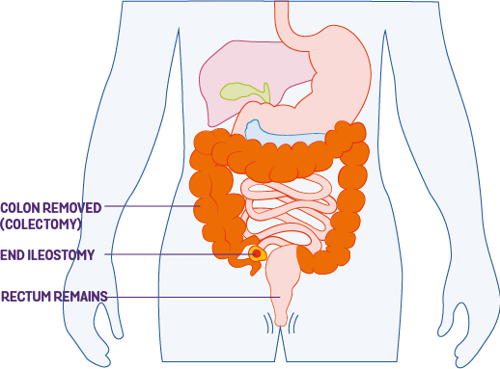
    The colon and rectum make up the large bowel. In this surgery, the surgeon removes the colon but leaves the rectum. The surgeon makes an ileostomy, which is a type of stoma, by joining a section of the small bowel to the surface of the tummy. Bowel contents pass out of this opening into a stoma bag.

    This type of surgery may be done in emergency situations.

    The ileostomy may be temporary or permanent. Some people may be able to have pouch surgery in the future, so the ileostomy is only temporary. Other people may decide to live with a permanent ileostomy.

    Completion proctectomy

    After a subtotal colectomy with ileostomy, part of the rectum and the anus are still in the body. Some people decide to then have another surgery called a ‘completion proctectomy’. Here, the remaining rectum and anus are completely removed. Because the anus is removed, some people call this ‘Barbie butt’ surgery. You might have a completion proctectomy because of symptoms from the remaining rectum, or cancer risk.

    If you choose to continue living with part of the rectum and anus inside, you might require regular camera tests to check for cancer. You might also need medicines for any remaining inflammation.

    Talk to your IBD team about your options to find out what is best for you.


    Panproctocolectomy with ileostomy

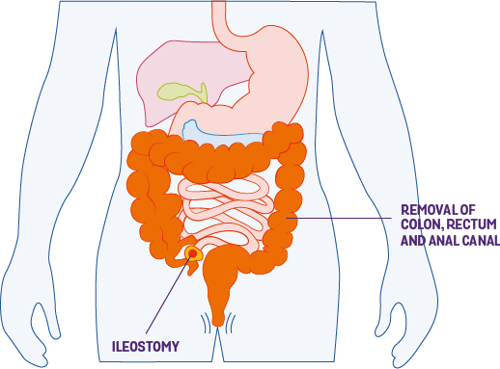
    In this surgery, the whole colon, rectum and anal canal are removed. The surgeon makes an ileostomy, which is a type of stoma, by joining a section of the small bowel to the surface of the tummy. Bowel contents pass out of this opening into a stoma bag.

    Panproctocolectomy with ileostomy surgery is irreversible. This means the ileostomy is permanent. But this also means that there is no colon and rectum to become inflamed or develop bowel cancer.


    J pouch surgery

    This surgery is also known as:

    • Pouch surgery
    • Ileoanal pouch surgery
    • Restorative proctocolectomy with ileal pouch anal-anastomosis (IPAA) surgery

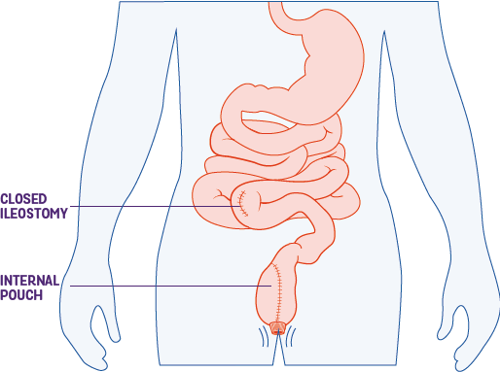
    In this surgery, the colon and rectum are removed, and the small bowel is joined to the anus. A pouch is made from the small bowel. This pouch is what stores poo until you are ready to go to the toilet.

    This type of surgery is often done in three different operations, or stages. But sometimes you only need two operations. Rarely, it all might be done in one operation. Your surgeon will discuss which option is best for you.

    The main stages in this surgery are:

    1.    Removing the colon and making a stoma.

    The surgeon removes all the colon but leaves the rectum and anus. The surgeon then joins a section of the small bowel to the surface of the tummy to make a stoma. This type of stoma is called an ileostomy. Bowel contents pass out of the stoma opening into a stoma bag.

    Sometimes, if people like life with their stoma, they decide not to have the further stages of J pouch surgery. They might go on to have a completion proctectomy in the future.

    2.    Making the pouch.

    The surgeon makes a J-shaped pouch from the ileum, a part of the small bowel. The bottom of the ‘J’ is joined to the top of the anus.

    3.    Closing the stoma.

    The stoma is closed. Poo can now travel down the ileum into the pouch.

    If you are having two surgeries, the pouch will be made at the same time as the colon is removed, and a stoma is made. Having a stoma gives the newly formed pouch a chance to heal.

    Advantages and disadvantages of pouch surgery

    Having pouch surgery means you can still poo out of your bottom. A pouch can give you some control of when you pass poo and wind. But a pouch cannot hold poo for as long as a healthy rectum. This means you will need to poo more times a day than if you had a healthy rectum. Typically, people with a pouch go to the toilet for a poo about six times a day, and at least once at night. Some people could experience some unintended leaking of poo, known as bowel incontinence.

    Pouch surgery involves cutting into the lower tummy area, called the pelvic area, which may affect fertility in some people. See the later section Surgery and everyday life.

    Pouch surgery can be a more complicated type of surgery, so it may not be carried out in your local hospital. If your doctor thinks pouch surgery could be suitable for you, you may be referred to a specialist hospital. You can also ask to be referred to a hospital which does a high number of pouch surgeries.

    “”

    Surgery was 100% the best option for me and I have been living symptom- and medication-free for 13 years with an internal pouch.


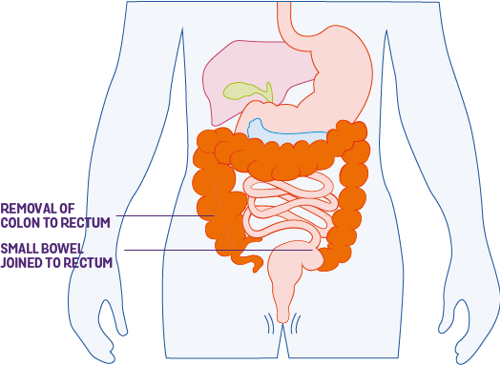
    Colectomy with ileo-rectal anastomosis

    In this surgery, the colon is removed and the end of the small bowel, called the terminal ileum, is attached to the rectum. This means you can poo out of your bottom and would not have a stoma.

    For this surgery to work, the rectum has to be healthy and not inflamed or scarred. If your anal muscles are damaged, there’s also a high risk that this surgery will not work. For these reasons, this type of surgery is not commonly used in Colitis. If you still have a rectum, there’s a risk of it becoming inflamed from Colitis. There’s also a risk of developing cancer in the rectum.

    Removing the colon means water cannot be absorbed as usual, so your poo may be quite watery. You may have to go to the toilet many times during the day and night.

    • Lots of healthcare professionals might be involved in your care if you need surgery.
    • Before planned surgery, you will have a pre-operative assessment. This helps your surgical team make your surgery the safest it can be.
    • Your surgical team may advise you to stop taking certain medicines before surgery. They should give you a plan for when and how you should stop taking them.

    Your IBD team

    Not everyone’s IBD team looks the same. But whoever you see, they’re all working to help keep you as healthy as they can. Your gastroenterologist, GP and IBD nurse may already be involved in your care. If you’re having surgery, your IBD team may also include your:

    • Surgeon. They will carry out your bowel surgery.
    • Stoma nurse. They will provide information and ongoing support if you have a stoma.
    • Dietitian. They can give advice on your diet and help you change your diet to improve symptoms.
    • Psychologist. They can help support you with your feelings and emotional wellbeing.

    When you have your surgery, you will also meet an anaesthetist. They will manage the anaesthetic and pain relief during your surgery. After your surgery, you will meet a physiotherapist. They will help you with movement and exercise.

    Not all IBD teams will have a psychologist. If you want support in managing your feelings, talk to your GP or IBD team. They may be able to arrange support for you. Depending on where you live in the UK, you may also be able to access mental health support directly, without a referral from a doctor. 

    • In England, you may be able to refer yourself directly to an NHS talking therapies service without referral from a GP.
    • In Scotland, you can refer yourself for an assessment for cognitive behavioral therapy (CBT) through Living Life.
    • In Wales, you can register for an online CBT programme through the NHS.
    • In Northern Ireland, your GP can refer you. There is no NHS self-referral option.

    Talking to your surgical team

    Before a planned surgery is booked in, you will meet a surgeon to discuss your operation. The surgeon will explain your surgical options in more detail. They will also talk through the benefits and risks of the surgery. They should mention any possible complications that can happen because of surgery. Let them know if there’s anything you do not understand. It’s OK to ask questions. It’s important that you find out about the things that are important to you. Our appointments guide includes some questions you may want to ask.

    At this stage, you may also meet a stoma care nurse if you’re going to have a stoma. They will be able to help with any questions you have about the surgery or your care after the surgery.

    You might find it helpful to talk to someone who has had surgery before you make your decision. The Ileostomy & Internal Pouch Association provide support volunteers who you can talk to. 

    “”

    I spoke to friends and family about it a lot. I tried to keep my focus on why I was having the surgery. I had spent so many months being ill so I was trying to remain positive and concentrate on how much better I would feel once it was done and recovered.

    If you decide to have surgery, you’ll be asked to sign a consent form. This is an agreement to say you understand the risks and benefits of the surgery. It is written proof that you give permission for the surgeon to carry out the operation. Even if you sign a consent form you can change your mind and withdraw consent at any point. If you cannot give consent, for example if you are under 16 years old, there are rules in place to help protect you. The NHS has more information on consent.

    “”

    Surgery is scary but being well informed helps to manage that fear.

    Pre-operative assessment

    Before planned surgery, you will have a pre-operative assessment. This helps your surgical team to make your surgery the safest it can be. It will also help the anaesthetist plan the best anaesthetic for you. Even if your surgery is done as an emergency, a surgeon and an anaesthetist will both assess you first.

    The pre-operative team is usually made up of nurses. They may call you to assess you, or invite you to the hospital for an assessment. They will ask about your medical history and home life. They may ask you to do some tests before your surgery. This could include blood tests, a heart tracing, known as an ECG, and chest X-ray. The tests you have will depend on your age, medical history, and the type of surgery you’re going to have.

    If possible, it’s good to be as fit as you can before surgery. This can help your recovery and lower your risk of complications. Your surgical team can give you advice on how to improve your fitness before surgery. This could include eating well, not smoking and being as active as you can be. If you are underweight, you may be advised to take extra nutrients. This may be in the form of a special liquid feed to have as well as your usual diet. If you are a smoker, your IBD team will support you to stop smoking. It’s important to stop smoking before you have surgery, as smoking increases your risk of complications.

    Anaemia is common in people with Colitis. Anaemia is when you have fewer healthy red blood cells to carry oxygen around the body. If you have anaemia, you should be treated for this before surgery, if possible.

    Medicines and surgery

    Your surgical team may advise you to stop taking certain medicines before surgery. They should give you a plan for when and how you should stop taking them.

    Medicines that may be stopped or changed include:

    • Steroids
    • The combined oral contraceptive pill
    • Blood-thinning medicines

    It’s important to tell your surgical team about all the medicines you are taking, including over-the-counter or herbal medicines. They will tell you which ones you need to stop or change before surgery. They may also advise you to start medicines before surgery. If you have other conditions, such as diabetes or high blood pressure, they will want to make sure these are under control before surgery.

    In some cases, you may need to take a strong laxative called a bowel preparation the day before surgery. This is used to completely empty your bowel. In other cases, you may be asked to have an enema to clear the last part of your bowel.

    Things to think about before having surgery

    • Transport. How will you get to and from hospital?
    • Next of kin. Who should the hospital contact with updates about your hospital stay? Are they ok with being contacted?
    • Work and volunteering. Will you need to take time off, and who should you talk to about this?
    • Caring responsibilities. Do you care for anyone, such as children, a relative, or a partner? Any pets? Who will be looking after them while you are in hospital and while you recover at home?
    • Pre-hospital instructions. Did your surgical team give you any instructions on what to do before coming in, like stopping medicines?
    • Going home. Will somebody be able to help you when you go home? Can you get food delivered?
    • Hospital visiting policy. When can people come to visit you?

    Packing for hospital

    This is not a full list, but it may help you plan your packing. Think about the size of the bag you take in. The hospital will not let you take in a big suitcase if there is limited space on the ward.

    • Loose-fitting, comfortable clothing. Try to bring both day and night clothing.
      Your usual medicines. This includes any inhalers, creams, or ointments.
    • Toiletries. For example, toothbrush and toothpaste, soap, shampoo, deodorant, mouthwash, moisturiser.
    • Charger for your phone.
    • Earphones or headphones.
    • Things to keep you busy, such as books, puzzle books, journals to write in.
    • Some people bring their laptop or tablet. Be aware that there may not be somewhere secure to store this. You will be responsible for looking after your valuables.
    • Lip balm.
    • Slippers or comfortable shoes.
    • Small comforts, such as a dressing gown or your own pillow.
    • Some people also like to bring squash for their water or their own snacks.

    Though most hospitals have Wi-Fi, it is not always reliable. You may want to download music, podcasts, or things to watch before coming into hospital, just in case there is no internet to use.

    • Before the day of your surgery, you should receive a letter explaining which hospital to go to. This might be a different hospital to the one you have your clinic appointments at. The letter will also tell you what time to arrive, and when to have your last meal and drink.
    • How long your surgery takes will depend on the exact operation you’re having.
    • Your surgical team can tell you how long they expect your surgery to take.

    On the day of your surgery, you will see several people. This includes a:

    • Surgeon. They will speak to you about the surgery and examine you before the operation.
    • Nurse. They will check your temperature, blood pressure, pulse, and weight. These will also be checked regularly during your surgery and while you recover in hospital.
    • Anaesthetist. They will talk about how you will be given the anaesthetic and how your pain will be controlled after the surgery.

    If you need a stoma, you will also see a stoma nurse. You will meet your stoma nurse beforehand to choose the best place for your stoma. You can find out more about planning a stoma in our information on life with a stoma.

    Signing a consent form

    If you have not done so already, you will be asked to sign a consent form. This will confirm that you agree to have the surgery. The surgeon should explain the form and what it means. If anything is unclear, ask for it to be explained. If you do not want the surgery to happen, you have the right not to sign the form.

    How long your surgery will take

    This will depend on the type of surgery you’re having, whether it is keyhole or open surgery and if you have had surgery on your tummy area before. If you have had surgery on your tummy before, you may have scar tissue called adhesions. Adhesions can sometimes make surgery more complicated, so it can take longer.

    • After surgery you will be moved to a recovery ward.  When you wake up, you may find some tubes attached to you.
    • Pain is expected after surgery, but you should not have to suffer. Being in pain can slow down your recovery and increase your risk of complications. If your pain is not under control, let someone know.
    • How long you’ll need to stay in hospital will depend on your individual situation. For the surgeries included in this information, it’ll probably be around seven to 10 days. But, some people may only need to stay in hospital for three to four days.
    • Generally, people who have had keyhole surgery are able to leave hospital sooner than people who have had open surgery.
    • If you were very unwell before your surgery, you may need to stay in hospital for longer.

    After surgery, you’ll be moved to a recovery ward. This is a small ward where nurses will monitor you as you wake up properly. The medicines that put you to sleep take a couple of hours to fully wear off. You may not remember waking up, or the first couple of hours after you wake up.

    The medicines used during surgery can make you feel sick. You may also have a sore throat. This is usually because of the tube that’s put into your throat to help you breathe during surgery. This tube is taken out when you wake up. If you feel unwell, let the nurses know and they’ll be able to help you.

    What are the tubes coming out of my body?

    When you wake up, you may find some tubes attached to you. Depending on the type of surgery, these may include:

    • A catheter. This takes urine out of your bladder. This is because you cannot naturally empty your bladder when you are put to sleep during surgery. A catheter is usually removed after a few days, when you can move around again and go to the toilet by yourself.
    • A wound drain. This drains blood and fluid from your wound after surgery. This is taken out when there is no more, or very little, blood or fluid left to drain.
    • An intravenous (IV) drip. These small tubes are used to give you fluids and medicines, like antibiotics and pain relief. Your IV drip may be changed every few days to lower the risk of infection.
    • A nasogastric tube. This tube goes in through your nose, down through your throat and into your stomach. This can be used to give you food directly into your stomach. It can also be used to drain your stomach to keep it empty. This may happen if you have a blockage in your bowel, or if you feel very sick.

    When you are fully awake and recovering well from the anaesthetic medicines you will be moved to a ward. For most people this will be a regular surgical ward. Some people need more monitoring. They will be moved to a specialty ward like a high dependency or intensive care unit. This may include people with other conditions, like heart or lung disease.

    Pain relief after surgery

    Your tummy will feel sore at first, and it may take a while to feel better. You may also notice some bruising and swelling on your tummy. This is common, and it should also get better. If it gets worse or you are worried that it’s not getting better, speak to your healthcare professional.

    Your doctors and nurses should talk to you about what pain relief may be best for you.

    The most common ways of having pain relief are:

    • Tablets or liquid to swallow.
    • Skin patches.
    • An injection into your vein. This is known as an intravenous (IV) injection.
    • An injection into a space in your spine, known as an epidural.
    • An injection into your tummy, known as an abdominal wall block.

    Patient controlled analgesia (PCA) is a type of IV drip pain relief. The patient controls when they get their pain relief by pressing a button. This is usually used for a short time after surgery when pain may be more severe.

    Preventing blood clots

    You’ll usually be given a pair of compression stockings to wear during your time in hospital. Compression stockings lower the risk of blood clots. You may also be given daily injections to help thin the blood to prevent blood clots. Your doctor should let you know if you need this or not and should advise you on how long you will need this for. See the section Lower your risk of complications while you recover for more information.

    Your recovery in hospital

    You will be encouraged to move as much as you can. This may mean getting out of bed and into a chair or walking around as soon as you are able. A physiotherapist may visit you to show you some simple leg and chest exercises.

    Having surgery can be a big shock to your body, mentally and physically. Your appetite may change and you may not feel very hungry. It may take some time for your appetite to return, especially if you were unwell before surgery. Your hospital team will let you know when you can start eating again after surgery. You’ll start off by drinking fluids. You’ll then move on to a liquid diet such as soup and jelly, before going on to solid foods.

    After surgery, your bowel may temporarily stop moving food and gas as it usually does. This can cause you to feel sick and bloated. Your doctor may suggest that you do not eat during this time, usually around one to two days.

    If you have a stoma, your stoma care nurse will teach you how to look after it and how to manage your stoma bag. If you have any problems, do not hesitate to ask for help.

    Lower your risk of complications while you recover

    Chest infections
    After surgery, you may be at a higher risk of chest infections. You can help lower this risk by doing breathing exercises. Ask your physiotherapist or surgical team how to do these exercises. If it hurts to take deep breaths, ask your nurse or doctor for pain relief.

    Blood clots
    You are at a higher risk of blood clots if you have had surgery, are having a flare-up or you’re in bed for a long time. You can help lower your risk by keeping moving as much as you can. At first this may only be moving your feet around. When you can get out of bed into a chair you can move your legs more. Try to walk as soon as you are ready. You should also wear the compression stockings given to you to help lower your risk.  

    • When you feel better will be different for each person.
    • When you first get home, you might feel quite weak and tired. You may not feel like doing much. But as time goes on, you’ll notice your strength coming back.
    • It’s important to listen to your body and only do as much as feels comfortable. Everybody is different, so try not to put too much pressure on yourself to get back to your usual life straight away.
    • Your follow-up plan with your IBD team will depend on your individual situation.

    Physical activity

    You should avoid any strenuous exercise for at least a few weeks after your surgery. This includes housework and lifting anything heavier than a full kettle for at least the first four to six weeks. This is so your wounds can heal properly.

    “”

    I couldn't even lift a full kettle when I was first home. When I had to be on my own, my dad would make a flask of tea for me to have throughout the day, as this was easier for me to lift and pour. I also found it very useful to wear loose long T-shirts or nightgowns (no bottoms with waistbands) so that clothing didn't pull on my stomach which was very sore for the first few days.

    After a few weeks, you should be able to gradually introduce exercise into your daily routine. A gentle exercise programme may help speed up your recovery and you will likely be given advice on this by your surgical team.

    Follow-up

    You should still be under the care of a gastroenterology team and a surgical team. You may have a nurse come to your home to help with any wounds, if this is needed. Make sure you understand your follow-up plan when you are discharged from hospital. If you do not know, make sure to ask someone. It is also worth asking:

    • What symptoms should I look out for?
    • Who should I contact if I’m concerned?

    If you have had stoma surgery, your stoma nurse is there to help. Having a stoma can be a big change and it may take a while to get used to it. Talk to the stoma care nurses if you need more information or have any issues. Many hospitals have stoma clinics or offer a stoma care advice line. See our information on life with a stoma.

  • Eating and drinking

    After your surgery, you may have to change what you eat for a short time. Your surgical team will give you specific advice on what you should eat. For example, they may advise you to eat a diet low in fibre. This will make it easier for your gut to break down and absorb food while it recovers from surgery.

    As you recover, you may find that you can eat larger meals and a wider range of foods.

    Most people with a stoma do not need to stay on a special diet. But there might be some foods or drinks that make your stoma more active or give you bad gas. This is different for everyone. Your stoma care nurse or the hospital dietitian should be able to advise you.

    You can see our information on food for more on diet and Colitis. Or see our information on life with a stoma for specific information on eating with an ileostomy.

    Hydration

    Your colon, part of your large bowel, is important for absorbing water. If you have your colon taken out, you have a higher risk of dehydration. You may find it helps to drink extra fluids and rehydration drinks, including electrolyte mix. You might find our information on dehydration helpful. Our information on life with a stoma also has information on staying hydrated with a stoma.

    Emotional reactions

    Everyone reacts to surgery in their own way. And it’s important to remember there is no right or wrong way to feel.

    As you go through the process of needing and having surgery, your emotions may change. Emergency surgery can be especially difficult as there is less time to adjust. Throughout this time, you may feel worried, scared or maybe nervous. You may feel a sense of relief.  Or, if you chose to have surgery, you may doubt whether you made the right decision. Try and be kind to yourself, and recognise you are going through a lot. Take time to look after yourself and do not be afraid to ask for help if you need it.

    Going through lots of different emotions can be exhausting. You may find it helpful to talk to someone about these feelings. IBD nurses, stoma nurses and psychologists can all help to support you. You can also speak to your GP about local mental health support. Our information on mental health and wellbeing has further details about this.

    Some people find it helpful to talk to someone else who has been through surgery. The Ileostomy & Internal Pouch Association provide trained peer support volunteers who you can talk to. 

    People close to you may also find it difficult to cope with the thought of you having surgery. Our information on supporting someone with Crohn’s or Colitis might be helpful in supporting them and their emotions.

    Driving

    In the long term, surgery should not affect driving. However, you may have to avoid driving straight after surgery. You should not drive again until you are able to control a car properly, including making an emergency stop if needed. This may take several months. If you still cannot drive safely three months after your surgery, you need to tell the Driver and Vehicle Licensing Agency (DVLA). Your car insurance may not cover you if you drive before you are fully recovered, so check the terms of your policy. It may be helpful to ask your surgeon to confirm that you can drive again in writing, at your follow-up appointment.

    Work and finances

    If you work, you may wonder how surgery will affect your job and your income. It can take time before you feel able to return to work. For some people this might mean three weeks, but for others, it is more. Some surgeons will sign you off for six weeks as standard. How long you will need off work will depend on the type of surgery you’re having and the type of job you have. If you work in a very physical job, you may need more time off.

    If you can, it’s best to let your employer know early on about your medical needs and time off so they can make adjustments. It may help to read our information on employment.

    If you are absent for more than a week, you will need to get a ‘fit note’ from the healthcare professional who is caring for you. They can make suggestions for additional support or adjustments when returning to work. This could include building up slowly to your usual working hours and duties. This is called a ‘phased’ return to work.

    See the Advisory, Conciliation and Arbitration Service (ACAS) website for more information on returning to work after an absence.

    If you’re worried about money, have a look at our information on money and finding financial support. You may be eligible for support. You can also visit the UK Government website or Citizens Advice for more information on welfare benefits. If you care for a child who lives with Colitis, you may want to read our information on disability benefits for children to see you if are eligible for financial help.

    Sex and relationships

    You may be worried about how surgery will affect your sex life. Your surgical team can give you specific advice about when they think it’s safe for you to have sex after surgery. Going back to sexual activity may mean exploring other ways of being intimate or new positions. It can be difficult to talk about sex, but being open about your needs and concerns can help.

    Some people who have surgery for Colitis may not be able to have anal sex. This will depend on the surgery you have. We have separate information about this in sex and relationships.

    For some men, having surgery may lead to difficulties with erections. This issue may go away by itself. But if not, speak to your IBD team or GP for ways to help.

    Our sex and relationships information has more on how surgery may affect sex and suggests other ways you could be intimate with a partner.

    Body image

    Your body may look different after surgery, and you may find this difficult to come to terms with. On the other hand, you may feel that having surgery improves your body confidence. You may feel better and able to do the things you enjoy. Maybe you can start going to the gym. If you’re having worries, talk to your IBD team.

    Your nurses will likely have spoken to lots of people about their body image worries. It may also be helpful to speak to others who have been through a similar experience. Check our support for you page for ways you can connect to others living with Crohn’s or Colitis. Our information on mental wellbeing may also be helpful.

    Emotional reactions

    Everyone reacts to surgery in their own way. And your emotions may even change during the process. You may feel worried or scared, maybe nervous. You may feel a sense of relief. Or you may feel doubt about whether having surgery was the right decision. Going through lots of different emotions can be exhausting. Emergency surgery can be especially difficult as there is less time to adjust. The people close to you may also find it difficult to cope with the thought of you having surgery.

    You may find it helpful to talk to someone about these feelings. IBD nurses, stoma nurses and psychologists can support you. You can also speak to your GP about local psychology services. Our information on mental health and wellbeing has further details about this.

    It may be helpful to talk to other people who have had surgery for their Colitis or who have a stoma. Check our support for you page for ways you can connect to others living with Crohn’s or Colitis.

    Body image

    Your body may look different after surgery and you may find this difficult to come to terms with. On the other hand, you may feel that having surgery improves your body confidence. You may feel better and able to do the things you enjoy. Maybe you can start going to the gym. Or maybe you have the energy to be intimate with a partner again. If you’re having worries, talk to your IBD team. Your nurses will likely have spoken to lots of people about their body image worries. It may also be helpful to speak to others – friends, family, or other people who have been through a similar experience. Check our support for you page for ways you can connect to others living with Crohn’s or Colitis. Our information on mental wellbeing may also be helpful.

    “”

    My main worry about having surgery was the body image of having a stoma and then scars (I was 19) but the freedom from symptoms was a much better feeling than any negativity of body image. I was also very worried about incontinence but this has not been an issue for me.

    Travelling

    Having surgery should not stop you travelling. You may be advised not to fly in the first couple of weeks after surgery. Blood clots are more likely to develop when you sit still for a long time, like on long-haul flights. And this risk is higher if you have had surgery recently. Ask your surgical team if they have any specific advice for you about travelling. If you have a stoma, you’ll have to consider packing your supplies. You can read more about travelling with Colitis in our information on travelling.

    Travel insurance

    When declaring your medical conditions, insurance companies will normally ask you if you have had surgery because of your Colitis. The cost quoted to you may be affected if you are waiting for surgery or have recently had surgery. Our information on travelling has more on getting travel insurance.

    Exercise and physical activity

    In the long term, having surgery should not affect how you exercise. If surgery helps your symptoms, it may mean you can be more active. If you have a stoma, you may have to make sure you have spare bags and other supplies with you.

    Having surgery in the tummy area, especially stoma surgery, can put you at a higher risk of getting a hernia. A hernia happens when there’s some weakness in the muscle wall, so internal organs like the bowel can push through. You can lower your risk of getting a hernia by working on your core strength and practising tummy exercises. The York and Scarborough Teaching Hospitals have produced a leaflet with some examples of core stability exercises you could try.

    There is more on how you can exercise with Colitis in our information on being active with Crohn’s or Colitis. Colostomy UK and the Ileostomy and Internal Pouch Association also have information on exercising after surgery.

    Fertility

    Some types of surgery for Colitis can affect fertility. If you’re thinking of having children, it’s important to let your surgical team know. For some people, it may be possible to delay surgery until they have completed their family. For other people, they may be able to have keyhole surgery. The risk of fertility problems is lower with this type of surgery.

    You should still use contraception if you do not want to get pregnant, or do not want to make someone pregnant after surgery.

    You can find out more about how Colitis affects fertility in our information on reproductive health and fertility.

    Male fertility after surgery

    After having pouch surgery, you may have problems getting or keeping an erection.  For most men, this improves with time, or with sildenafil medicine. Sildenafil is also known by the brand name Viagra. After pouch surgery, some people develop a rare complication called retrograde ejaculation. This is when the semen goes back towards the bladder instead of out the penis. The risk of this is lower after having keyhole surgery.

    Female fertility after surgery

    If you have had pouch surgery, also known as restorative proctocolectomy with ileo-anal pouch (IPAA), you may have more difficulty getting pregnant. Other surgeries in the pelvis, like proctectomy, may also affect your fertility. It’s thought that surgery in your pelvis could cause scarring around the fallopian tubes and ovaries. This may cause fertility problems. The risk of fertility problems is lower in women who have had keyhole surgery.

    In vitro fertilisation (IVF) may be an option to help you get pregnant after surgery. IVF is just as successful in women with Colitis who have had pouch surgery as in everyone else.

    Uncontrolled Colitis can affect female fertility. You can find out more in our information on reproductive health and fertility.

    Pregnancy

    If you become pregnant, either before or after surgery, your doctors will advise you on which options are safest for you and your baby.

    If you have had pouch surgery, you will often be advised to have a C-section. This is because of the risk associated with vaginal deliveries. In vaginal deliveries, the muscles around the anus can get torn or cut. For people with a pouch, damage to these anal muscles could cause incontinence.

    C-sections are also more common in women who have a stoma. We have more information in our resource on pregnancy and birth.

    School or university

    You may need to take some time out of studying to recover from surgery. Try to speak to your school, college or university as early as you can so they are aware of the situation. They may be able to give you extended deadlines or adjustments for exams. Crohn's in Childhood Research Association (CICRA) have more information on Colitis and schools.

    “”

    The majority of my surgeries have been during school and university, so I arranged studying from home and extensions.

    Children and young people

    Much of the information here will apply to children as well. However, there are some things to be aware of:

    • Surgery on children and young people often takes place in specialist hospitals. This may mean you have to travel further for the surgery.
    • Children aged 16 or over can consent to treatment. Children under 16 might also be able to consent to their own treatment. This can only happen if they have a full understanding of what their treatment involves.

    CICRA has more information on surgery in children with Colitis.

    “”

    I was only 10 so I spent some time wearing a bag pre surgery to get used to it on my tummy, sometimes we filled it with water to get used to the sensation of it being full, we also put a bag on my teddy bear.

  • We follow strict processes to make sure our information is based on up-to-date evidence and is easy to understand. We produce it with patients, medical advisers and other professionals. It is not intended to replace advice from your own healthcare professional.

    We hope that you’ve found this information helpful. Please email us at evidence@crohnsandcolitis.org.uk if:

    • You have any comments or suggestions for improvements.
    • You would like more information about the evidence we use.
    • You would like details of any conflicts of interest.

    You can also write to us at Crohn’s & Colitis UK, 1 Bishop Square, Hatfield, AL10 9NE. Or you can contact us through our Helpline by calling 0300 222 5700.

    We do not endorse any products mentioned in our information.

Help us improve our information

We need your help to improve our information to better support people with Crohn’s and Colitis. Fill in our short survey to let us know what we're doing well and how we can better meet your needs.

Page
saved

This page has been saved in your personal space. Go to “My Page” to view all saved pages.

Helpline service

Helpline Service

We know it can be difficult to live with, or support someone living with these conditions. But you’re not alone. We provide up-to-date, evidence-based information and can support you to live well with Crohn’s or Colitis.

Our helpline team can help by:

  • Providing information about Crohn’s and Colitis.

  • Listening and talking through your situation.

  • Helping you to find support from others in the Crohn’s and Colitis community.

  • Providing details of other specialist organisations.

Please be aware we’re not medically or legally trained. We cannot provide detailed financial or benefits advice or specialist emotional support.

Please contact us via telephone, email or LiveChat - 9am to 5pm, Monday to Friday (except English bank holidays).

Live chat

If you need specific medical advice about your condition, your GP or IBD team will be best placed to help.

Stay in the loop

Together, we’re making the greatest difference. Sign up to hear about the amazing things we’re achieving together.

Privacy Policy

© Crohn's & Colitis UK

Would you like to save the changes made to this page?