Types of X-rays and imaging scans
Abdominal X-rays or tummy X-rays
An X-ray is taken of your tummy to look for areas of swollen bowel above blockages and obstructions. X-rays can also be used to diagnose toxic megacolon. Toxic megacolon is a widening or swelling of the colon that may cause a rupture, known as a perforation. These X-rays are often used in emergency cases. They do not show as much detail of the gut as some of the other imaging scans below.
X-rays are very quick to perform.
Barium studies
Barium is a white, chalky fluid that is not absorbed into the body. Instead it forms a temporary coating on the inside of the gut. Since X-rays cannot pass through the barium coating, it is used to provide a clearer outline of the gut on X-ray pictures.
You will be asked to take barium in different ways, depending on the part of the gut that is being looked at.
Barium studies have become less common because CT and MRI imaging scans are more widely available.
The different types of barium tests are:
- Barium swallow and meal. The radiologist will ask you to drink a barium liquid. You will do this while they take X-ray images of the upper part of the gut, such as your oesophagus and stomach.
- Barium follow-through. You will swallow a barium liquid. The radiologist will take X-ray images every 30 minutes as the barium passes through your small intestine.
- Barium enema. An enema is used to pass barium directly into your bowel through a short tube placed in your bottom. Your bowel must be empty of poo before the test. This can help to make sure the images are clear. If you need to take laxatives before the test, you should be given instructions on what to eat and drink.
After taking barium, your poo will turn pale and chalky looking for a few days.
Chest X-rays
Biologics and other targeted medicines can affect your immune system. They may increase your risk of infections, such as tuberculosis (TB).
Before starting these medicines, you will need to have a chest X-ray to check you do not have a latent TB infection. A latent infection is when the TB bacteria is in your body but is not active, and you do not have any symptoms. People with latent TB are not infectious. This type of X-ray is very quick to perform.
DEXA (dual energy X-ray absorptiometry) scans
DEXA scanners use low-dose X-rays to measure how dense or strong your bones are. It usually checks the bones in your hip or lower spine. This is a simple, painless test that takes around 10 to 20 minutes.
DEXA scans can show if your bones have become thinner and weaker. This can be caused by conditions, such as osteoporosis. People with Crohn’s or Colitis have an increased risk of developing osteoporosis. Having steroid treatment or low calcium levels can also increase the risk of weak bones. If you take steroids long-term, you may have regular DEXA scans. You can read our information on bones for more information.
Computerised tomography (CT) or computerised axial tomography (CAT) scans
A CT scanner is a special machine that uses a series of X-ray beams to build up a detailed picture of the inside of your body. During a CT scan, you usually lie on a movable bed. This slowly passes through the centre of the scanner. The scanner is a ring that rotates around your body while it takes each scan. The scan is quick and painless.
You may be given a contrast dye before the scan. This helps show more detail of the gut on the scans taken. The contrast may be given in the form of:
- A drink to swallow
- An enema in your bottom
- An injection into a vein in your arm
You should get a letter telling you everything you need to know about the scan. This will include if you need to have a contrast dye.
Another type of CT scan is CT enterography. This scan is used to look at your small bowel in more detail. Usually, you will have to drink a contrast dye before the scan. During the scan, another type of contrast dye will be injected into a vein in your arm.
Magnetic resonance imaging (MRI)
MRI scans use strong magnets and radio waves to create images of the inside of the bod. MRI scans do not use X-ray radiation. The MRI scanner is a large machine with a short tunnel. You will be asked to lie very still on a movable table, which slides slowly inside this tunnel. An MRI will usually last between 15 minutes and one hour.
You may be given a contrast dye before the scan. This helps to show more detail of the gut on the scans taken.
MR enterography (MRE) is a special type of MRI. This scan is used to look at your small bowel in more detail. Usually, you will have to drink a contrast dye before the scan. During the scan, another type of contrast dye will be injected into a vein in your arm. MR enterography scans help find inflammation, blockages and bleeding in the small bowel.
The MRI scan can be noisy and make tapping sounds. You may be given earplugs or headphones to wear. The radiographer controls the MRI scanner from another room but can still see and hear you to make sure everything is going okay. If you are scared of enclosed spaces, let a healthcare professional know that you are worried before the test. They can offer support and help you feel more comfortable.
If you feel very anxious about having an MRI scan, you may want to ask your GP or consultant for a mild sedative. This is a medicine to help you feel sleepy and relaxed. You should arrange this before your MRI appointment.
Because MRI scanners use magnets, they are not suitable for most people who have implanted metal or an electronic device, such as an artificial joint or pacemaker. Please let your team know, and they can check if your implant or device is compatible and suitable for an MRI scan.
You should get a letter telling you everything you need to know about the scan, including if you need to have contrast dye.
Another type of MRI is a magnetic resonance cholangiopancreatography (MRCP). This scan shows detailed images of:
- The liver
- Gall bladder
- Bile ducts
- Pancreas and pancreatic ducts
An MRCP can be used to diagnose primary sclerosing cholangitis (PSC). This is a condition that affects your liver and gallbladder.
Ultrasound
Ultrasound scans use sound waves to create detailed images of parts of the body. It can be used to find thickening of the bowel wall, abscesses and strictures. It does not use X-ray radiation. To create the image, a radiographer moves a scanning probe or wand over the part of the body they want to examine.
Before the scan, you will need to drink large amounts of liquid. You may be asked to avoid eating for a few hours. You may be given a contrast dye before the scan, which helps show more detail of the gut on the scans taken.
You should get a letter telling you everything you need to know about the scan, including if you need to drink any contrast dye.
Endoscopic ultrasound scans (EUS) use a special endoscope with a tiny ultrasound transmitter in the tip. Like a standard endoscope, EUS may be either:
- Inserted through the mouth to examine the upper part of the gut
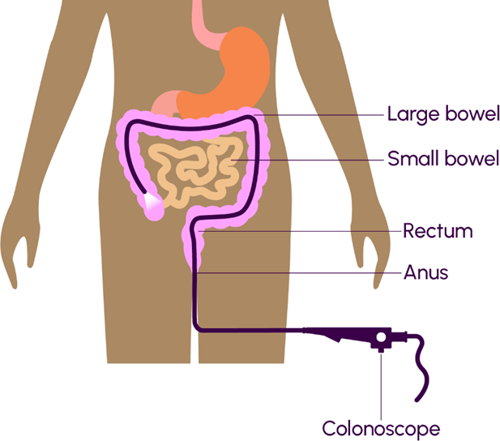
- Inserted through the bottom to examine the colon, part of the large bowel, and ileum, the last part of the small bowel
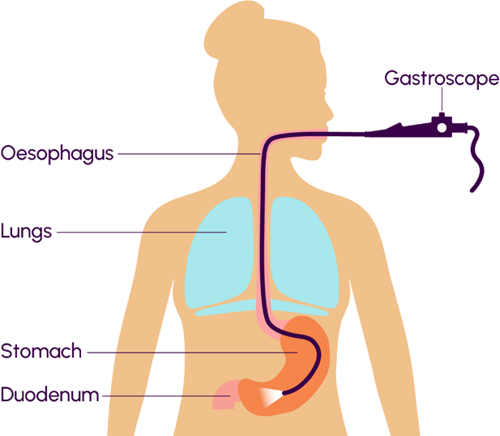
Your doctor will be able to take small samples if they need to. These are known as biopsies. You will usually be given a sedative or a local anaesthetic spray to numb your throat. Find out more in the section above on endoscopy.
SeHCAT Scan
A SeHCAT scan is used to find out whether diarrhoea is caused by bile acid malabsorption (BAM).
Your body makes bile salts in the liver and stores them in the gallbladder. When you eat, bile salts are released into the small bowel to help break down food. Usually, when bile salts reach the end of the small bowel, they are absorbed into your blood. Bile salts may not be absorbed if the last part of the small bowel, known as the ileum, is inflamed or has been removed during surgery. Instead, bile salts enter the colon, which is part of the large bowel, along with high levels of water, leading to watery diarrhoea.
The SeHCAT scan involves two separate appointments.
- At your first appointment, you will be asked to swallow a small capsule that contains a small amount of radioactive bile salts. Less than three hours later a scan will be taken using a machine that can measure radioactivity.
- After seven days, a second scan will measure the amount of radioactive bile salt still left in your body. This can show whether you have problems absorbing bile salts.
There is no need to be concerned about the level of radiation you are exposed to. This is because the radiation dose is low. It is equivalent to the amount of radiation you receive from natural sources of radiation in about two months. You will not need to stay away from anyone after the scan.
You should get an information sheet with your appointment letter from your hospital. This will tell you everything you need to know about the scan.

 SEARCH