Involving people in developing IBD care takes centre stage

Published: 07 July 2021

In the 6th year of national co-production week, our health services and research officer, Gemma, shares our latest work on involving people with Crohn's and Colitis.

We also highlight some of our projects already putting people with Crohn's and Colitis at the centre.

“”

We must be in touch with the people we represent.


The involvement of people with Crohn’s and Colitis is essential to our work. It helps to ensure our work resonates with people with Crohn’s and Colitis and addresses the issues most important to them. And we truly believe that we are stronger together, which is why involvement is a key thread in our values and strategy!

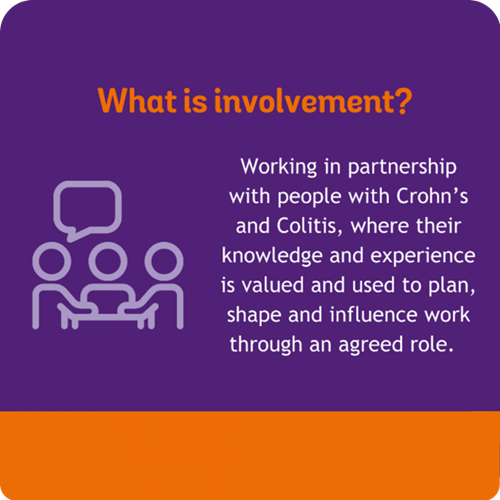
what is involvement graphic

Over the past year we have been reviewing our approach to involvement and have plans in place to build this area over the next 12 months.

“”

We have some exciting plans which we will share more detail on soon, but to give you a flavour of what’s to come, this will involve developing easier ways to search and sign up for involvement opportunities. As well as new resources, support, and recognition for everyone that gives their time and experiences to shape projects. Finally, we will be making every effort to make sure we are involving people from across the Crohn’s and Colitis community.

Not only do we strive to involve people with Crohn’s and Colitis in our work, we also advocate for and support partners, researchers, and healthcare professionals to involve people in theirs.

One key area which we do this in health services. Working in partnership with IBD UK, the IBD Standards state that patients and parents/carers should have direct involvement and a voice in the development of the service.

“”

I joined the Patient Panel to help give something back to the hospital community and support the staff team who have supported me so amazingly since day one.

Giving people living with Crohn’s and Colitis an active role in the planning, development, delivery, and review of their healthcare services supports and empowers them to live well. They are experts in their own condition and their involvement in developing services is essential to the modernisation of the NHS. This also creates improved services and better outcomes.

We’ve seen that bringing together healthcare professionals and patients is the most effective way to provide high-quality, sustainable health services. 

“”

People living with Crohn’s and Colitis have spoken so eloquently about how these conditions have touched every aspect of their lives. What is really striking for me is their rich knowledge of what does and doesn’t work in health services and the potential to use this knowledge in developing new models for the future.

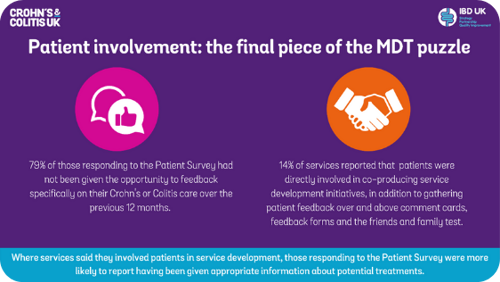
We know that there is still more to do - The IBD UK report Crohn’s and Colitis Care in the UK: The Hidden Cost and a Vision for Change showed that most people and most services do not currently involve people with Crohn’s and Colitis.

patient involvement graphic

Join us in making sure we don’t go back to normal as we come out of the pandemic, the first step is better care for everyone affected by Crohn's or Colitis. Together, we can get Crohn's and Colitis recognised by the NHS as a priority so that this can change.

“”

Putting people living with Crohn’s and Colitis at the centre of decision-making is already working.

Now, let's take a look at some exciting pieces of work that we have planned over the new few years, in which we’ll be leading the way with involvement in healthcare.


AWARE-IBD

Working with our local partners in Sheffield, this is one of only four projects to be funded under a new Health Foundation programme called Common Ambition. The aim of the three-year project is to re-design IBD services, shaped by those who use them – people with Crohn’s and Colitis. Whilst the project is being delivered in Sheffield, the learning from this project will lead to better outcomes for people who live with Crohn’s and Colitis across the UK. You can find out more about the project here and If you use the Sheffield IBD service, you can also sign up to the launch event to hear from the project team directly here.

Self-management in Scotland

We’ve just received funding from the Health and Social Care Alliance to develop a structured self-management programme for people with Crohn’s and Colitis in Scotland. This two-year project builds on our partnership work with The Scottish Government Modernising Patient Pathways Programme, which has already produced a flare card and care plan. Developing a structured self-management programme and embedding a person-centred approach to care into IBD services seemed a natural next step to this partnership work.

Page
saved

This page has been saved in your personal space. Go to “My Page” to view all saved pages.

Helpline Service

Temporary closure - 10/06/2026

Our Helpline will be closed from Wednesday 10 June and will reopen at 10am on Monday 15 June.

We may be closed but we have lots of information here on our website.

If you need urgent medical advice you can call NHS 111 or in Northern Ireland phone your local Phone First. In an emergency call 999 or go to your nearest A&E.

If you need emotional support the Samaritans are available 24 hours a day, 7 days a week on 116 123.


We know it can be difficult to live with, or support someone living with Crohn’s or Colitis. But we’re with you. We can give you the right information and support at the right time.

We’re here for everyone.

How Can We Help?

  • We can help you understand Crohn’s and Colitis
  • Listen and talk about living with IBD
  • Help you connect with others in the Crohn’s and Colitis community
  • Give you contact details of specialist organisations
  • We can support you to live well with Crohn’s or Colitis and provide up-to-date, evidence-based information

Please be aware we’re not medically or legally trained. We cannot provide detailed financial or benefits advice or specialist emotional support.

Please contact us via telephone, email or LiveChat - 10am to 3pm, Monday to Friday (except English bank holidays).

Live chat

If you need specific medical advice about your condition, your GP or IBD team will be best placed to help.

Would you like to save the changes made to this page?