
 SEARCH
A report for BBC Radio's Newsbeat programme linking eating junk food with developing Crohn's Disease has been described as 'distressing' and not backed up by hard evidence.
Crohn's and Colitis UK hits back at junk food media reports

The broadcast on Wednesday 18 June was then followed up by articles and broadcasts in the national media, even though there has been no definitive scientific link made to any particular diet or food additive as being a sole cause of the disease.
On our Facebook page and Twitter feed, Crohn's and Colitis UK members and supporters voiced their concern and upset over the damage caused by the report and the Charity was quick to respond to all the inaccuracies.
We ensured these misleading statements were corrected in the Daily Telegraph and Daily Mail, arranged for Professor Chris Probert from our Clinical Advisers team to appear on BBC News 24, ensured there was a change to the BBC website report, and took part in numerous regional radio interviews in addition to Radio 2’s Jeremy Vine show.
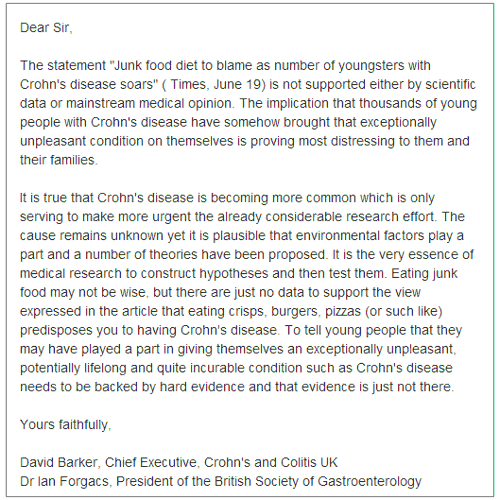
A jointly-written letter published in The Times by David Barker, Chief Executive of Crohn’s and Colitis UK, and Dr Ian Forgacs, President of the British Society of Gastroenterology, explained why headlines such as the newspaper’s “Junk food diet to blame as number of youngsters with Crohn's disease soars” were simply wrong. While eating junk food ‘may not be wise’, there is no data to support the view that eating crisps, burgers, and pizzas predisposes anybody to developing Crohn's Disease.
Expert's view
By Professor Chris Probert, Gastroenterologist at the University of Liverpool and a Crohn's and Colitis UK Clinical Adviser
Crohn’s disease in younger people is becoming more common and is a worldwide phenomenon and not something confined to the UK ( In UK children it has increased by about 50% over the last decade rather than the 300% stated in some recent media reports). We are better at diagnosing Crohn’s disease now so we are finding more cases in younger people than before and while it has been suggested that junk food might be an explanation, it’s one of many theories and it is by far from proven – there’s actually no evidence that junk food is the cause of Crohn’s disease.
An increase in the number of cases going to hospital isn’t the same as the increase in the number of people with Crohn’s disease. We now have treatments for Crohn’s disease that take people to hospital to have treatment for short periods of time. The treatment is offered every two months to most patients, that means they appear to go into hospital 6-8 times a year, so that instantly inflates the number of people attending hospital with Crohn’s disease. There is now greater recognition of intravenous treatments for anaemia with patients with Crohn’s disease – i.e. intravenous iron is preferable in some patients to oral iron - and so they go to hospital and they might be recorded as admissions as well. Younger people with Crohn’s disease can now have their investigations under general anaesthetic and in some hospitals that’s also recorded as an admission.
The significant increase in cases is something that we are very concerned about, however, we are very happy that new drugs on offer are changing patient's lives dramatically and the quality of life for younger people receiving some of these drugs is vastly different from that of a decade ago.
We will continue to monitor and inform media about the scientific facts behind Crohn's disease and Ulcerative Colitis.
What's your view?
Join the debate at our Facebook page. Here's a selection of Facebook comments regarding the media reports:
“”
I think the media seem to forget that Crohn's disease has become easier to diagnose... so it might not even be that there are so many new cases to Crohn's... it might be a case of these people going so long being undiagnosed.
“”
It's hard enough living with an invisible illness and trying to explain to people what you go through daily whilst appearing perfectly normal on the outside without people now thinking its self inflicted!
“”
Very disappointing. Why no mention of compromised immune systems? Made it sound as if all Crohn's sufferers had previously gorged on burgers and sweets. Waste of an excellent opportunity to really educate the public.
Read our latest news
Catch up on the latest news from Crohn’s & Colitis UK


Page
saved
This page has been saved in your personal space. Go to “My Page” to view all saved pages.
Helpline Service
We know it can be difficult to live with, or support someone living with Crohn’s or Colitis. But we’re with you. We can give you the right information and support at the right time.
We’re here for everyone.
How Can We Help?
- We can help you understand Crohn’s and Colitis
- Listen and talk about living with IBD
- Help you connect with others in the Crohn’s and Colitis community
- Give you contact details of specialist organisations
- We can support you to live well with Crohn’s or Colitis and provide up-to-date, evidence-based information
Please be aware we’re not medically or legally trained. We cannot provide detailed financial or benefits advice or specialist emotional support.
Please contact us via telephone, email or LiveChat - 10am to 3pm, Monday to Friday (except English bank holidays).

If you need specific medical advice about your condition, your GP or IBD team will be best placed to help.
Stay in the loop
Together, we’re making the greatest difference. Sign up to hear about the amazing things we’re achieving together.
© Crohn's & Colitis UK