
 SEARCH
New research led by Professor Bernie Carter and Professor Pam Qualter has shown that young people who experience severe Crohn's and Colitis symptoms are more likely to experience poor mental health and need extra support. It is thought that the experiences and feelings of young people may offer specific challenges and so they might need a little extra support.
Research Shows Young People with Crohn's and Colitis Need More Mental Health Support

In this new article, published in the journal of Quality of Life Research, Pam, Bernie and their team present the results of their 'Being Me With IBD' study. They asked 130 young people who have Crohn's or Colitis - the two main forms of Inflammatory Bowel Disease (IBD) - about their feelings of depression, anxiety, loneliness, friendship quality, and embarrassment.
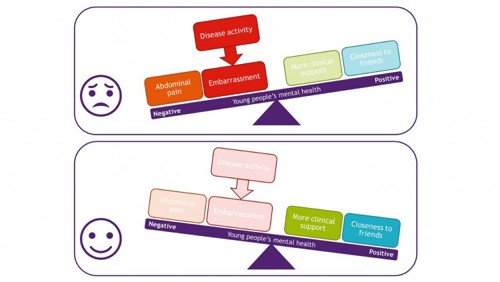
They found that experiencing more severe symptoms, such as tummy pain, was related to developing mental health problems.
Essentially, their research shows that an unpredictable bout of disease activity -such as a flare -causes anxiety and embarrassment about symptoms like pain, belly noises, incontinence and/or need to rush to the toilet. This leads to not wanting to take part in social activities and this can lead to loneliness and poor mental health.
“”
The team hope that this study will increase the recognition of this problem and open up more opportunities for young people with Crohn's or Colitis to talk about their mental health in clinic. This would provide them with clinical support to address the challenges associated with Crohn's and Colitis, including the impact it has on social activities and mental health. Our findings shine a light on aspects of Crohn's and Colitis that are of importance to young people, but which may be overlooked in clinic visits.
Typically, consultations do not address young people's feelings, mental health, or the challenges that these conditions can create for sustaining friendships and connectedness. While the focus on physical symptoms is important, our study reveals the importance of creating opportunities for talking about well-being and mental health.
“”
While it was not a surprise to find that mental health challenges were common among adolescents and young adults with IBD, we found that those were brought about because of the embarrassment surrounding the condition and the perceived negative impact symptoms had on friendships.
It seems important, then, that patients have opportunities to discuss their mental health within their usual clinics, and that sustained friendships with peers are encouraged. In addition, our findings highlight the need to increase awareness of Crohn's and Colitis, increasing the scope for compassion and understanding among youth.
The team's next steps include developing information sheets for parents of adolescents and young adults with Crohn's or Colitis. These aim to help support them in engaging in open and honest discussion about their conditions. We're really thrilled that Bernie and her team will be presenting this work as an interactive 'virtual poster' at our next IBD Patient and Public Involvement in Research Day on Saturday 17th October 2020.
The results of our recent Life in Lockdown survey suggest that these findings are particularly relevant and important just now, with almost half of people with Crohn's and Colitis reporting that their mental health has been negatively impacted by the coronavirus pandemic.
“”
We are incredibly proud to support the research that Bernie, Pam and their team have produced as part of their 'Being Me With IBD' project. It has shone a light on the need for extra mental health support for young people with Crohn's and Colitis and, by identifying the root causes, provides the tools to address the problem clinically.
We hope that this takes us a step closer to improving the mental wellbeing for thousands of young people with Crohn's and Colitis.
Please remember that if you ever need to talk about your condition, or that of a loved one, our fantastic Helplines team are here to help. We also have a new, comprehensive mental health and wellbeing resource that you might find helpful.
Related information:
- Read their most recent publication for free
- Find out more about the 'Being Me With IBD' project funded by Crohn's & Colitis UK
- Access the free information sheets developed by Bernie's team
- See how we are working to tackle pain in Crohn's and Colitis
Read our latest news
Catch up on the latest news from Crohn’s & Colitis UK


Page
saved
This page has been saved in your personal space. Go to “My Page” to view all saved pages.
Helpline Service
Last updated: 22/07/2026
Our Helpline team can't take calls, chats or ring you back for the rest of the summer. But you can still reach us by email.
If you need to contact the team, please email helpline@crohnsandcolitis.org.uk and we'll answer you as soon as possible.
Thanks for bearing with us.
How Can We Help?
- We can help you understand Crohn’s and Colitis
- Listen and talk about living with IBD
- Help you connect with others in the Crohn’s and Colitis community
- Give you contact details of specialist organisations
- We can support you to live well with Crohn’s or Colitis and provide up-to-date, evidence-based information
Please be aware we’re not medically or legally trained. We cannot provide detailed financial or benefits advice or specialist emotional support.
If you need specific medical advice about your condition, your GP or IBD team will be best placed to help.
Stay in the loop
Together, we’re making the greatest difference. Sign up to hear about the amazing things we’re achieving together.
© Crohn's & Colitis UK