Reducing your risk
You cannot always prevent bowel cancer, but there are things you can do to lower your chance of getting it.
Follow your treatment plan
Long-term inflammation is linked to developing bowel cancer. Following your treatment plan and taking your medicine as prescribed gives your bowel a chance to heal. This may reduce your risk of developing bowel cancer.
Taking a 5-ASA or aminosalicylate on its own for treating Colitis has been linked to a lower risk of developing bowel cancer. It is not clear whether this is also the case for people who are taking a 5-ASA with an advanced treatment such as a biologic or other targeted medicines.
Try to keep in touch with your IBD team and attend your appointments, even when you feel well. Your IBD team can help you find ways to manage your condition effectively, including helping you find the best treatment. Speak to your GP or IBD team if you notice any changes in your symptoms that you’re worried about.
Have regular colonoscopies
Regular colonoscopies allow specialists to check for early changes in the colon before cancer develops. This is known as a surveillance colonoscopy.
See the section on Surveillance colonoscopies for more information.
Make healthy lifestyle changes
Some of the lifestyle changes you can make to reduce your risk of bowel cancer include:
- Being more active. Take a look at our information on being active with Crohn’s or Colitis for tips to help you exercise.
- Reducing the amount of red and processed meat you eat.
- Reducing the amount of alcohol you drink. For cancer prevention, it’s best not to drink alcohol at all.
- Stopping smoking if you smoke. You can get help from Quit smoking - NHS (www.nhs.uk)
- Eating plenty of fibre from wholegrains, pulses, vegetables and fruit. For some people with Crohn’s or Colitis, increasing fibre makes symptoms worse. Increase your fibre intake gradually to reduce wind and bloating. You should not increase your fibre intake if you have a stricture. See our information on Food for tips on increasing the amount of fibre in your diet.
See Bowel Cancer UK for more details on reducing your risk through lifestyle changes.
Surveillance colonoscopies
A surveillance colonoscopy is a ‘check-up’ colonoscopy. Its aim is to look for any changes in the lining of the bowel that might suggest a higher risk of bowel cancer.
In people with Ulcerative Colitis or Crohn’s affecting the colon, colonoscopy surveillance can reduce the development of bowel cancer. By detecting bowel cancer early, surveillance can reduce the rate of death associated with bowel cancer.
When should I be offered my first surveillance colonoscopy?
You should be offered an initial surveillance colonoscopy:
- About eight years after your symptoms started if you have Crohn’s or Colitis affecting your colon or rectum
- At diagnosis if you have Crohn’s or Colitis and are diagnosed with primary sclerosing cholangitis (PSC)
During the colonoscopy, the specialist will look at the lining of the colon and rectum. They will look for:
- How inflamed it is
- The presence of polyps or dysplasia
The specialist may remove polyps or tissue samples so they can check them under a microscope.
If a pre-cancerous change or a cancer is discovered, your IBD team will discuss your options with you and help to come up with a treatment plan. Most polyps and pre-cancerous tissue can be removed at the time of the colonoscopy. If there are many areas of pre-cancerous change or the change is advanced, then your IBD team may talk to you about surgery to remove part or all of the bowel.
How often should I have a surveillance colonoscopy?
The first surveillance colonoscopy will help your doctors to agree your risk of bowel cancer.
After this colonoscopy, some people may not need further surveillance colonoscopies. This is because their risk of bowel cancer will be similar to people without Crohn’s or Colitis. But most people are likely to be offered regular follow-up surveillance colonoscopies. This allows specialists to check for early changes in the lining of the bowel before cancer develops. How often you have a follow-up colonoscopy will depend on your risk of getting bowel cancer.
The British Society of Gastroenterology (BSG) suggests:
A surveillance colonoscopy every year if:
- You continue to have moderate inflammation, or you have dysplasia, PSC or a colonic stricture, or
- Your risk of progressing to advanced dysplasia or bowel cancer after 5 years is calculated to be moderate
A surveillance colonoscopy every three years if:
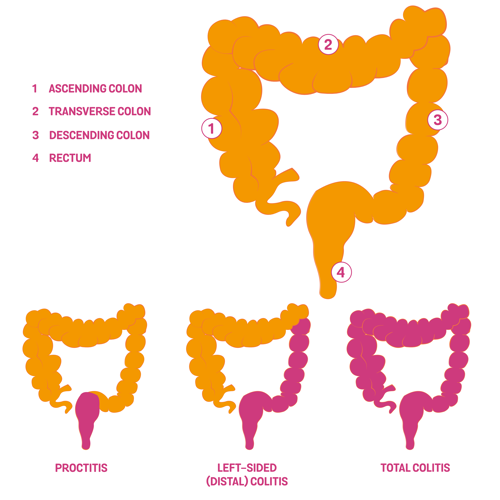
- You have mild active inflammation, Ulcerative Colitis that affects most or all your colon, Crohn’s that affects more than half of your colon or inflammation in three or more sections of your colon, or post-inflammatory polyps
- Your risk of progressing to advanced dysplasia or bowel cancer after 5 years is calculated to be small
- You have a close relative who has bowel cancer
A review of your risk every 10 years if:
- You have none of the risk factors above
- Your risk of progressing to advanced dysplasia or bowel cancer after five years is similar to the general population.
- If you have proctitis you will not need surveillance colonoscopies unless your colon becomes inflamed. Having proctitis does not increase your risk of developing bowel cancer.
- In these cases, you should still take part in the NHS bowel cancer screening programme when offered.
It’s best to have a surveillance colonoscopy when your Crohn’s or Colitis is in remission, if possible. This is because it can be difficult to see dysplasia if your bowel is very inflamed.
How effective are surveillance colonoscopies?
Colonoscopy is the best way to detect bowel cancer early, and even prevent it. Bowel cancer can be prevented by removing pre-cancerous polyps during a colonoscopy.
But sometimes cancer or dysplasia (pre-cancerous changes) can be missed during a colonoscopy. This might happen because:
- It is not always possible to reach the entire large bowel during a colonoscopy
- The bowel preparation (bowel prep) might have not cleaned the bowel enough to see the cancer or dysplasia
- Small, flat areas of dysplasia can be difficult to see
- Ongoing bowel inflammation may make it difficult to see the cancer or dysplasia
- In some cases, a polyp may not have been removed fully so cancer later develops
The colonoscopy will usually last around 30 to 45 minutes. To help you feel more comfortable, you may be offered:
- Painkillers
- Sedation – a medicine to help you feel sleepy and relaxed.
- Nitrous oxide - a medicine to help you relax that you breathe in, known as ‘gas and air.’
We understand that you may feel nervous or worried about having a colonoscopy. Special effort should be made to make you as comfortable as possible. Your procedures should be carried out by endoscopists with experience of surveillance colonoscopy in people with Crohn’s or Colitis. They will have the techniques needed to identify and deal with pre-cancerous changes. They should also perform the colonoscopy with enough sedation and time to make sure the examination is as comfortable as possible for you.
New bowel preparations are available for people with Crohn’s or Colitis. This may make bowel cleansing before the colonoscopy more bearable.
If you have an appointment for a colonoscopy, it's important that you attend. The earlier bowel cancer is found, the more likely it can be treated successfully. Talk to your IBD team about the risks and benefits of having regular colonoscopies.
If you think you are due to have a surveillance colonoscopy but have not been invited for one, contact your IBD team. Contact your IBD team or GP if you’re worried about any of your symptoms in between colonoscopies.
Bowel cancer screening
The NHS bowel screening programmes in the UK are for everyone, whether you have Crohn’s or Colitis or not.
You’ll use a home testing kit called the faecal immunochemical test (FIT). You will usually be sent this when you reach a certain age, depending on where you live. FIT looks for tiny amounts of blood in a small sample of your poo. It is different to the faecal calprotectin test, which is a poo test that looks for signs of inflammation in your gut.
You should complete the FIT test even if:
The FIT test may show blood in your poo that needs further investigation. In this situation a healthcare professional will assess you. They should discuss with you any previous investigations or treatment. And they should provide support and advice on the next steps and whether you have any further investigation. This will usually be a colonoscopy. Blood in your poo won’t always mean you have cancer. Your FIT may show blood in your poo due to Crohn’s or Colitis.
The age when you are offered FIT depends on where you live in the UK. See detailed information for your nation:
Find out more about Bowel cancer screening (www.nhs.uk)
If you have symptoms of bowel cancer, some IBD teams may ask you to complete a FIT. This can help them to decide how urgently you need a colonoscopy.
Finding out that you have bowel cancer
Treatment has the best chance of working if bowel cancer is found at an early stage. If you are at risk of developing bowel cancer you will be regularly checked. So, if you develop cancer, it’s likely to be found at an earlier stage. Nearly everyone survives bowel cancer if diagnosed at the earliest stage.
If you are diagnosed with bowel cancer, your healthcare team will talk to you about the benefits and risks of the different treatment options. The most common treatment for bowel cancer is surgery. Other treatments include chemotherapy and radiotherapy.
For more on bowel cancer diagnosis and treatments, see:
These charities offer information and helpline services if you have any questions or need extra support.

 SEARCH