Steroids

Last full review: August 2026

Next review date: August 2029


PIF tick logo

Steroids are medicines used to treat Crohn’s Disease, Ulcerative Colitis and Microscopic Colitis. They work by helping to lower inflammation. Steroids are also called corticosteroids.

If you’re taking steroids or thinking about taking them, this information can help you better understand and manage your treatment.

This information is for people in the UK. It should not replace advice from your IBD team.

In this information, when we use the word ‘Colitis’ we mean Ulcerative Colitis and Microscopic Colitis.

Download the information below (PDF)

Help us improve our information

We need your help to improve our information to better support people with Crohn’s and Colitis. Fill in our short survey to let us know what we're doing well and how we can better meet your needs.

Key facts about steroids

  • Doctors can use steroids to treat Crohn’s Disease, Ulcerative Colitis and Microscopic Colitis. Steroids can help lower inflammation. They are often used to help you feel better quickly if you are having a flare-up. But they might not work for everyone.
  • You usually take steroids as a short-term treatment. They’re more likely to cause side effects if you take them for a long time.
  • There are different types of steroids, which you take in different ways. Steroids can be taken by mouth, put into your bottom, given as an injection, or as an infusion into a vein.
  • Steroids that are released directly in your bowel can have fewer side effects.
  • It’s important that you do not stop taking steroids suddenly. For oral steroids, you may need to lower the dose gradually to prevent side effects.

More Information

  • Steroids are hormones that your body makes. The steroids used to treat Crohn’s and Colitis are man-made versions of these hormones. The doses you take are much higher than the amount your body makes.

    At these higher doses, steroid medicines lower the activity of your immune system. This can help to lower inflammation.

  • There are different types of steroid medicines used to treat Crohn’s and Colitis. The type you have will depend on:

    • Where the inflammation is in your gut
    • How unwell you are

    Steroid medicines have different names depending on:

    • The drug name. This is the chemical that treats your condition. This is also called the active ingredient.
    • The brand name. The same medicine may be available from different pharmaceutical companies. Each company may give their medicine a different name. This is the brand name.
    • How you take the medicine. The same steroid may come in different forms. You take different forms in different ways. Different forms may have different names.

    The steroids used to treat Crohn’s and Colitis are not the same as anabolic steroids. Anabolic steroids are the ones some athletes may use to improve performance.

    Oral steroids

    Oral steroids are taken by mouth.

    Standard oral steroids

    Some oral steroids enter your blood soon after you take them. This means they can affect your whole body quickly. This is useful if you feel very unwell. It also means they are more likely to cause side effects.

    Standard oral steroids include:

    • Prednisolone. Brand names include:
      • Deltacort
      • Deltacortil
      • Deltastab
      • Pevanti
    • Methylprednisolone. Brand names include Medrone.

    Delayed-release oral steroids

    Some oral steroids are made to release slowly. They are called delayed-release or prolonged-release tablets.

    The tablet does not release the medicine until it reaches your bowel. This helps the medicine work directly on the area of your bowel that has inflammation.

    This also means less of the steroid goes into your blood. Because of this, delayed-release steroids are less likely to cause side effects than standard oral steroids. But you can still get side effects with delayed-release steroids.

    Delayed-release oral steroids include:

    • Budesonide. Brand names include Budenofalk and Entocort.
    • Beclometasone diproprionate. Brand names include Clipper.
    • Budesonide-MMX. Brand names include Cortiment.

    Different delayed-release steroids work in different parts of the gut. Your IBD team will choose the steroid that works where you have inflammation.

    Intravenous (IV) steroids

    Intravenous steroids go straight into your blood. This means they can work much faster if you are very unwell and need treatment quickly.

    Intravenous is often called IV.

    It also means they may have a higher risk of side effects than taking steroids by mouth. But the risk of side effects also depends on the dose and how long you take it for.

    You will usually only have intravenous steroids if you need urgent treatment. You will have these in hospital. Steroids that can be given intravenously include:

    • Hydrocortisone
    • Methylprednisolone

    Rectal steroids

    Rectal steroids are put into your bottom. They work directly in the end of your colon and rectum. Rectal steroids are usually used if you have inflammation in these parts of your gut.

    Because the steroid works directly on the area of inflammation, less of it goes into your blood. Because of this, rectal steroids are less likely to cause side effects than standard oral steroids. But you can still get side effects with rectal steroids.

    Steroids that can come in rectal applications include:

    • Prednisolone.
    • Budesonide. Brand names include Budenofalk, Budesonide Dr Falk Pharma and Entocort.
  • If you have a flare-up, steroids can help to quickly lower the inflammation in your gut. This can help you to feel better and get your symptoms under control. This is known as inducing remission. Read more about flare-ups.

    Steroids should not be used to keep you in remission. Once your symptoms are under control, your doctor will offer you a different medicine.

    “”

    "Steroids cannot be used long-term, but can be very helpful during flare-ups. So do not be afraid to try them if your doctor recommends and them updated on your symptoms."

    Some people taking steroids might be newly diagnosed with Crohn’s or Colitis. For support and information, see our resource for people newly diagnosed with Crohn’s or Colitis.

    Steroids for Crohn’s Disease

    You might be offered steroids when you’re first diagnosed with Crohn’s Disease, or if you’re having a flare-up.

    You might be given oral budesonide if you have a mild to moderate flare-up affecting the end of your small bowel.

    If you have a flare-up affecting your large bowel, you may need standard oral steroids.

    Steroids are not used for long-term treatment, also called maintenance treatment, of Crohn’s Disease.

    Steroids for Ulcerative Colitis

    You might be offered steroids if you’re having a flare-up of Ulcerative Colitis. For mild to moderate flare-ups, your doctor will usually only offer you steroids if:

    • 5-ASAs are not right for you, or
    • if 5-ASAs have not controlled your symptoms on their own.

    The type of steroid you take will depend on the part of your bowel that has inflammation, and how severe it is. If you’re having a severe flare-up, you may need standard oral steroids.

    Steroids are not used for long-term treatment, also called maintenance treatment, of Ulcerative Colitis.

    Steroids for Acute Severe Ulcerative Colitis

    Acute Severe Ulcerative Colitis (ASUC) is a serious flare-up of Ulcerative Colitis. If you have ASUC, you will usually be treated with intravenous steroids in hospital. Intravenous steroids work quickly, so you should start to feel better within a few days. If you do not start to feel better, your IBD team will discuss other possible treatment options with you.

    Steroids for Microscopic Colitis

    You might be offered oral budesonide to treat a flare-up of Microscopic Colitis. Steroids are usually used for a short time to help get your symptoms under control.

    Sometimes you may be able to take budesonide for longer to keep your symptoms under control. This is called maintaining remission.

    Who cannot take steroids

    Some people may not be able to take steroids. Before being offered them, your IBD team will check if steroids are suitable for you. Read more about checks before starting steroids.

    Deciding which medicine to take

    There can be lots of things to think about when starting steroids.

    Your IBD team should carefully consider the benefits and risks before they offer you a medicine. They will help you decide together about which medicine is best for you.

    If you’re offered steroids, your IBD team will talk to you about your options. Sometimes there may only be one option. This depends on what is safe and suitable for you.

    You might want to think about any questions you have and what matters most to you. To do this, you may find these resources useful:

    Changing medication

    If one steroid does not work for you, you may be able to try another. For example, if the first steroid does not help your symptoms or if you have side effects.

    This is not always possible. Each steroid works in a slightly different way. Some types may not be suitable for you.

  • You will need some checks before you start treatment with steroids. This is to make sure they’re right for you. Your IBD team will check if you:

    • Are pregnant, planning to get pregnant or breastfeeding
    • Recently had a vaccination, or plan to have any vaccinations
    • Have had surgery recently, or plan to have surgery
    • Have ever had chicken pox
    • Are taking any other medicines

    Your IBD team will also check if you have any of the following:

    • An infection. If you have an infection, you may need to wait until it has gone before starting steroids.
    • Liver problems. The levels of steroids in your blood may increase if your liver is not working properly.
    • Mental health conditions. This includes psychosis, severe depression, or bipolar disorder. Steroids can trigger these conditions or make existing problems worse.
    • Wounds. Steroids may slow down wound healing. Your IBD team will also check if you have wounds from recent surgery or are going to have surgery soon. 
    • Problems with your eyes, such as glaucoma. Steroids can make some eye problems worse.
    • Other current health conditions. Steroids can make other conditions worse. Your IBD team may need to check other health conditions more carefully. This includes: 
      • Heart problems
      • High blood pressure
      • Bone problems, such as osteoporosis
      • Diabetes
      • Epilepsy
      • Stomach ulcers
    • Cancer. Steroids may cause complications with some types of cancer.
    “”

    Steroids cannot be used long term but can be very helpful during flare-ups. So don’t be afraid to try them if your doctor recommends and keep them updated on your symptoms.

    If you have Crohn’s Disease

    You may have steroids when you’re first diagnosed with Crohn’s, or if you’re having a flare-up. You may be prescribed oral budesonide if you have a mild to moderate flare-up affecting the end of your small bowel. If you have a flare-up affecting your large bowel, you may need standard oral steroids.

    If you have Ulcerative Colitis

    You may have steroids if you’re having a flare-up of Ulcerative Colitis. Your doctor will usually only offer you steroids if aminosalicylates (5-ASAs) are not right for you. Or if they have not controlled your symptoms on their own. The type of steroid you take will depend on the part of your bowel affected. You might try budesonide MMX, beclometasone dipropionate (Clipper) or rectal steroids. If you’re having a severe flare-up you may need standard oral steroids.

    If you have Acute Severe Ulcerative Colitis (ASUC)

    Acute Severe Ulcerative Colitis (ASUC) is a serious condition. If you have ASUC, you’ll usually be treated with intravenous steroids in hospital. Intravenous steroids work quickly, so you should start to feel better within a few days. If you do not start to feel better, your IBD team will discuss other possible treatment options with you.

    If you have Microscopic Colitis

    You may have oral budesonide to treat a flare-up of Microscopic Colitis. Sometimes you can have it longer term, to keep your symptoms under control. Microscopic Colitis includes Collagenous Colitis and Lymphocytic Colitis.

  • Understanding clinical trial results

    The information below shows the results of clinical trials. These trials looked at how effective steroids are.

    To find this out, scientists compared people who took steroids with people who took a placebo. A placebo is something that looks the same as the treatment but does not have any medicine in it.

    You can find out more about clinical trials in our information on the effectiveness of medicines.

    How well steroids work for Crohn's Disease

    Steroids usually work well to lower and control Crohn’s disease symptoms during a flare-up.

    Prednisolone for Crohn’s Disease

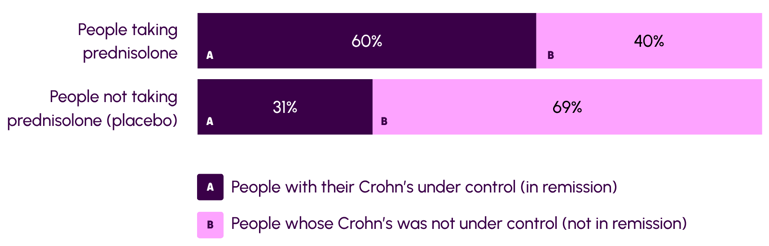
    Two large studies have looked at how well steroids work in Crohn’s. They compared a total of 267 people taking either prednisolone or placebo.

    The studies looked at how many people had their Crohn’s under control after up to 17 weeks of treatment. The diagram below shows the combined results of the studies.


    A diagram showing the results of the studies comparing prednisolone to placebo for Crohn's Disease.


    The diagram shows that after up to 17 weeks of taking prednisolone, 6 in every 10 people, or 60%, had their Crohn’s under control. And 4 in every 10 people, or 40%, did not have their Crohn’s under control.

    Of those who had the placebo, around 3 in every 10 people, or 31%, had their Crohn’s under control. And around 7 in every 10 people, or 69%, did not have their Crohn’s under control.

    Budesonide for Crohn’s Disease

    Budesonide is not always as good at treating flare-ups as standard oral steroids.

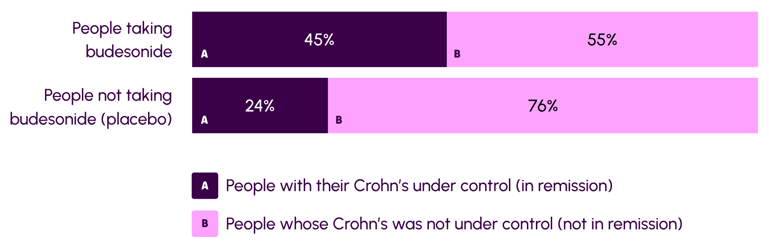
    Several studies have compared budesonide to placebo for getting Crohn’s disease under control. The diagram below shows the combined results of all these studies.


    A diagram showing the results of the studies comparing budesonide to placebo for Crohn's Disease.


    The diagram shows that of the people who took budesonide, 45 in 100 people, or 45%, had their Crohn’s under control. And 55 in 100 people, or 55%, did not have their Crohn’s under control.

    Of those who had the placebo, around 1 in every 4 people, or 24%, had their Crohn’s under control. And around 3 in every 4 people, or 76%, did not have their Crohn’s under control.

    How well steroids work for Ulcerative Colitis

    Oral steroids for Ulcerative Colitis

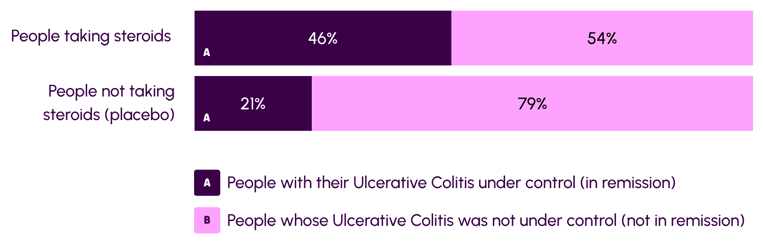
    Five studies compared different oral steroids with placebo for treating Ulcerative Colitis. The diagram below shows how well steroids got Ulcerative Colitis under control after up to 8 weeks of treatment.


    A diagram showing the combined results of studies comparing different oral steroids to placebo for Ulcerative Colitis.


    The diagram shows that after up to 8 weeks, 46 in 100, or 46%, of people taking oral steroids had their Ulcerative Colitis under control. And 54 in 100 people, or 54%, did not have their Ulcerative Colitis under control.

    Of those who had the placebo, around 2 in every 10 people, or 21%, had their Ulcerative Colitis under control. And around 8 in every 10 people, or 79%, did not have their Ulcerative Colitis under control.

    Some people who did not have their condition under control may have had an improvement in their symptoms.

    Budesonide-MMX for Ulcerative Colitis

    Budesonide-MMX is less effective than standard oral steroids at treating flare-ups.

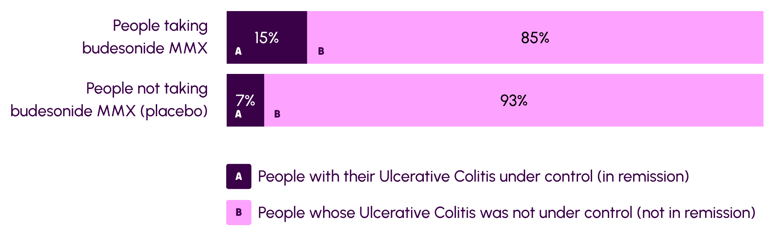
    Studies have compared budesonide-MMX with placebo for the treatment of Ulcerative Colitis. The table below shows the results of these studies.


    A diagram showing the results of studies comparing budesonide-MMX to placebo for Ulcerative Colitis.


    The diagram shows that of the people who took budesonide-MMX, 15 in 100, or 15%, had their Ulcerative Colitis under control. And 85 in 100 people, or 85%, did not have their Ulcerative Colitis under control.

    Of those who had the placebo, 7 in 100 people, or 7%, had their Ulcerative Colitis under control. And 93 in 100 people, or 93%, did not have their Ulcerative Colitis under control.

    How well steroids work in Microscopic Colitis

    Getting symptoms under control

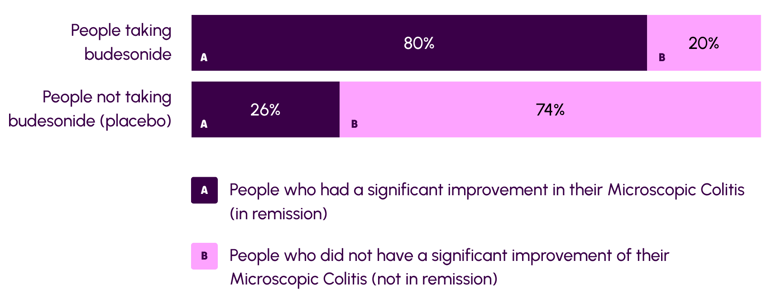
    Budesonide can be used to treat Microscopic Colitis. Several studies have compared budesonide to a placebo for getting symptoms under control. This is also called inducing remission. The image below shows the combined results of these studies.


    A diagram showing the results of studies comparing budesonide to placebo. The treatment is for getting Microscopic Colitis symptoms under control.


    The diagram shows that of the people who took budesonide, 8 in every 10 people, or 80%, had a significant improvement in their Microscopic Colitis. And 2 in every 10 people, or 20%, did not have a significant improvement.

    Of those who had the placebo, around 1 in every 4 people, or 26%, had a significant improvement in their Microscopic Colitis. And around 3 in every 4 people, or 74%, did not have a significant improvement.

    Keeping symptoms under control

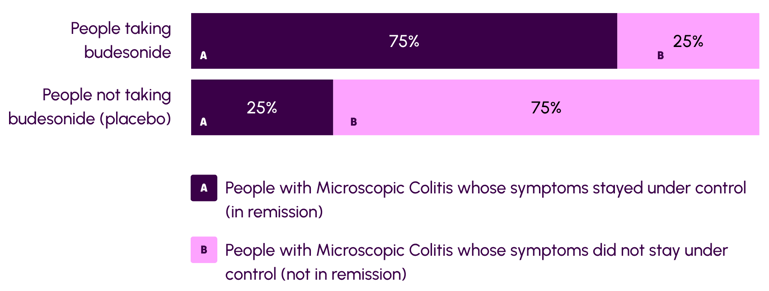
    Budesonide is occasionally used for a longer time to keep Microscopic Colitis symptoms under control. This is called maintaining remission. There have been 2 studies that compared budesonide to a placebo for maintaining remission. The combined results of these 2 studies are shown in the image below.


    A diagram showing the results of studies comparing budesonide to placebo. The treatment is for keeping Microscopic Colitis symptoms under control.


    The diagram shows that of the people who took budesonide, 3 in every 4 people, or 75%, stayed in remission. And 1 in every 4 people, or 25%, did not stay in remission.

    Of those who had the placebo, 1 in every 4 people, or 25%, stayed in remission. And 3 in every 4 people, or 75%, did not stay in remission.

  • Some types of steroids work more quickly than others. How quickly they work varies from person to person. Steroids often work faster than other medicines used for Crohn’s and Colitis.

    • Oral steroids typically take 1 to 7 weeks to start working.
    • Rectal steroids typically take 1 to 2 weeks to start working, but can take up to 4 weeks.
    • Intravenous steroids typically take 3 to 5 days to start working.

    Steroids might not work for everyone. Some people may be offered a different treatment. You can read more in the stopping and changing medicines section.

  • How you take steroids will depend on how severe your Crohn’s or Colitis is, and which part of your gut is affected. It’s important to always follow the advice from your healthcare team about how to take your medicine. The patient information leaflet that comes with your medicine also has information on how to take it.

    If your GP has prescribed you steroids, your IBD team should be told.

    Oral steroids

    You take oral steroids by swallowing them. They can come in:

    • Tablets
    • Capsules
    • Granules
    • Dissolvable tablets
    • Liquids

    Your healthcare team might suggest ways of taking your medicine that can help to lower the risk of side effects. This might include taking it:

    • In the morning
    • With food

    Delayed-release oral steroids

    You may need to take delayed-release oral steroids in a different way to other oral steroids. For example, you may need to take these before food in the morning.

    It’s important to swallow these medicines whole and not to chew, crush or break them. This may stop them from working.

    Intravenous (IV) steroids

    This is when steroids are given directly into a vein. This can be via:

    • An injection.
    • An infusion. This uses a small plastic tube, called a cannula, which goes into your vein. The tube passes the medicine slowly into your blood.

    Intravenous steroids are used for severe flare-ups and usually give the quickest response. You only have intravenous steroids in hospital.

    Rectal steroids

    These are steroids that you put into your bottom as an enema, rectal foam, or suppository.

    • Enemas and rectal foams are liquids or foams. You put these into your bottom with an applicator.
    • Suppositories are small bullet-shaped capsules of medicine. You put these into your bottom. 

    Read the instructions that come with your steroids. This will explain the best way to use them and often has pictures to help.

    Find out more about how to use rectal products like suppositories and enemas.

    It may take some time to get used to taking rectal steroids. Do not worry if you do not get it right the first few times. Many people get used to using rectal steroids after a few tries.

    If you are having difficulty using your medicine, talk to your IBD team.

    How much to take

    Below are examples of doses for adults. The dose you have may be different to these examples.

    • Prednisolone tablets

    A common dose to start on is 20-40mg, although it may be more. Your doctor may then gradually lower the dose.

    • Methylprednisolone tablets

    A common dose to start on is up to 48mg a day. Your doctor may then gradually lower the dose.

    • Budesonide tablets, capsules or granules

    A common dose is 9mg a day for 8 weeks. This may either be as a single dose, or split into 3 doses. Your doctor may gradually lower the dose for a further 2 to 4 weeks.

    • Beclometasone dipropionate

    A common dose is a 5mg tablet once a day, for up to 4 weeks.

    • Rectal foam or suppository

    There are several steroids that can be taken as a rectal foam or suppository. A common dose is 1 or 2 applications a day, for between 2 and 8 weeks.

    • Intravenous steroids

    A common dose of hydrocortisone is 100 mg, 4 times a day. A common dose of methylprednisolone is 60mg once a day. You will have this in hospital.

    Do not make any changes to your dose or how you take your steroids without talking to your IBD team.

  • Although steroids are produced naturally in your body, the amount of steroids in medicines is much higher. This can cause side effects.

    All medicines can have side effects, but not everyone gets them. At least half of people taking steroids for Crohn’s and Colitis have some side effects.

    • Some side effects can happen straight away. Others may happen after you have been taking steroids for a while.
    • Some side effects are mild. Others may be more serious and could need treatment.
    • Some side effects may go away on their own. Others may go away after you stop taking steroids. Some may be long-lasting.

    Knowing about possible side effects can sometimes feel worrying. However, your IBD team should carefully assess the risks and benefits before prescribing steroids. They will only recommend steroids if they think they are the best way to improve your symptoms and overall health.

    There are many different steroid medicines. Each can have different side effects. We do not include every possible side effect of steroids in this resource. For more information about your specific medicine, read the Patient Information Leaflet in the box with your medicine. You can also find this on the Electronic Medicines Compendium website.

    Possible side effects

    Fluid retention

    Some people may get a more rounded face and gain more fat around their middle. This is caused by your body holding more fluid, and changes to your metabolism.

    If you have this, your IBD team may suggest lowering the amount of salt in your diet and eating more potassium-rich foods. This can help with fluid retention.

    Potassium-rich foods can include:

    • Fruit
    • Vegetables
    • Dairy

    Weight gain

    Steroids can increase your appetite, which can make you put on weight. Some people find it helpful to change what they eat during this time. Read more about eating well with Crohn’s or Colitis.

    Weight gain can be difficult to manage, especially as some people may already struggle with food due to their Crohn’s or Colitis. Some people may also have difficult feelings around weight gain and body image. If you are struggling with food or weight gain, speak to your IBD team.

    Sleep problems

    Sleep problems may be more likely if you have more than a single dose of steroids during the day. If you are having problems sleeping, ask your IBD team if you can take your medicine at a different time of day.

    Changes to menstrual cycle

    Steroids may disrupt your usual menstrual cycle, causing irregular periods.

    Skin changes

    This could include:

    • Spots, known as acne
    • Redness
    • More body hair
    • More sweating
    • Stretch marks caused by thinning of your skin

    Gut problems

    Some people get stomach pain or stomach ulcers, or feel sick, known as nausea.

    Possible serious side effects

    Adrenal insufficiency

    When taking some oral steroid medicines, your body may stop making enough of your own natural steroids. You might not notice any problems while you’re still taking steroid medication. If you suddenly stop your steroid medicine, your body may then not have enough steroids. This is called adrenal insufficiency.

    This can cause:

    • Tiredness
    • Not feeling as hungry as usual
    • Weight loss
    • Tummy pain
    • Feeling or being sick
    • Loose poo, also called diarrhoea
    • Headache
    • Pain in your joints
    • Dizziness
    • High temperature

    Adrenal insufficiency can be very serious. Read more in the section about stopping steroids safely.

    Mood changes

    Mood changes can include:

    • Depression
    • Irritability
    • Extreme highs and lows in your mood.

    If you are struggling with mood changes, let your IBD team know. They are there to support you.

    Joint, bone and muscle problems

    Taking steroids can weaken your bones. This is called osteoporosis. Taking steroids for 3 months or more increases your risk of osteoporosis.

    Steroids can also cause muscle and joint pain or muscle weakness.

    If you take a longer course of steroids, your doctor will usually give you vitamin D and calcium supplements. This helps protect your bones and keep them strong.

    If you take steroids for more than 3 months, you may also have a scan to check your bones. See the section on ongoing checks for more information.

    Eye problems

    Some people may get glaucoma, cataracts or other problems with vision.

    Delayed growth

    Some children and young people on steroids may grow at a slower rate. This is usually only with longer-term treatment. See the section on steroids in children to find out more.

    Diabetes or raised blood sugar levels

    Steroids may cause raised blood sugar levels or diabetes. But this can also be a result of changes in metabolism and hormone levels. Signs of diabetes include:

    • Being very thirsty
    • Needing to pee more often than usual
    • Blurry vision
    • Feeling very tired

    Higher risk of infections

    Steroids are immunosuppressant medicines. They affect the way your immune system works. This means your body might not be able to fight off infections as well as it usually does. Even a mild infection, such as a cold or sore throat, could become more serious.

    Read more in the section about reducing your risk of infections.

    What to do if you have side effects

    Tell your IBD team

    It’s important to tell your IBD team if you get any side effects. They can:

    • Help you manage side effects
    • Talk to you about other treatment options

    Having certain side effects might mean that steroids are not right for you. 

    Report to the MHRA

    We also encourage you to report any side effects to the Medicines and Healthcare Products Regulatory Agency (MHRA). You can do this through the Yellow Card scheme online or by downloading the MHRA Yellow Card app. This helps collect important safety information about medicines.

    Record your side effects

    Some people may get side effects that have not previously been reported or included in any information. It can be helpful to write down when you started taking a medicine and when any new symptoms begin. This may help you and your healthcare team work out if a new symptom could be a side effect. 

  • Steroids are usually taken for a short time, so you may not need regular checks. It’s important that you still contact your IBD team if:

    • You have any side effects
    • Your steroid treatment is not working

    If you need to take steroids for longer, your IBD team may see you regularly to check for some side effects. They may check your:

    • Blood pressure
    • Blood sugar
    • Eyes
    • Weight and height

    Adrenal insufficiency

    Your IBD team may check for signs that your body is not making enough steroids. This can make you very ill. For more information on this, see the section on side effects.

    Weak bones

    Steroids can weaken your bones. Your doctor should check your risk of bone fractures when you start taking steroids. To help protect your bones, they may suggest that you:

    • Have a bone density scan, also known as a DEXA scan.
    • Take a medicine called bisphosphonate. This can help keep your bones strong. If you’re pregnant, or trying for a baby, let your doctor know. Bisphosphonate treatment may not be suitable for you.
    • Take steroids that are less likely to cause bone weakness. This could be rectal steroids or budesonide. This is because they work directly in your bowel, so they are less likely to cause side effects in other parts of your body. But these steroids may not be suitable for everyone. You may need another type of steroid.

    If you are taking steroids for longer than 3 months, you should have a DEXA scan. Tell your doctor or IBD team if you have not had one and think you need to.

    Looking after your bones

    Other factors can increase the risk of having weaker bones or osteoporosis. The Royal Osteoporosis Society has a tool to check your risk of osteoporosis. You can use this tool to help you understand what might increase your chances of getting osteoporosis and broken bones.

    This tool cannot tell you if you have osteoporosis. It also is not made specifically for people with Crohn’s or Colitis.

    If you already know you have osteoporosis, or if you have had your bones checked by a doctor, this tool will not give you extra information. Follow the advice given by your healthcare team.

  • Your doctor will try to lower your risk by prescribing the lowest dose of steroids that works for you, and for the shortest amount of time. They may also prescribe a type of steroid that is likely to give fewer side effects.

    Everyone is different, and you may not be able to avoid every side effect from steroids. But there are things you may be able to do help lower the risk and stay safe while taking steroids.

    Steroid warning cards

    Your IBD team may give you a card with details of your steroid treatment. This will include the dose and how long you’ll be taking steroids.

    Always carry this card. Show it to any healthcare professional treating you, including dentists.

    You could also consider wearing a steroid warning bracelet.

    Lowering the risk of infections

    Steroid medicines are immunosuppressants. They can increase your risk of getting serious infections.

    Avoid close contact with people who have infections. This includes chicken pox, shingles or measles. You could become seriously ill from these illnesses.

    Tell your doctor if:

    • You come into contact with anyone who has an infection
    • You feel unwell and think you might have an infection

    There are other things you could consider doing to lower your risk of infections. Read more about precautions when taking immunosuppressant medicines.

    Vaccinations

    Certain vaccines, called live vaccines, are not safe for people taking steroids for Crohn’s or Colitis. Live vaccines are made using weakened versions of living viruses or bacteria. They’re not safe because steroids weaken your immune system, so you may be more likely to get a serious infection.

    You’ll need to wait 3 months after you stop taking steroids before having a live vaccine.

    Speak to your IBD team to make sure your vaccinations are up to date before you start taking steroids. If you have recently had a live vaccine, you should wait at least 4 weeks before starting steroids.

    If someone you live with is due to have a live vaccine, ask your IBD team if you need to take any special precautions.

    In the UK, live vaccines include:

    • Rotavirus vaccine. This is only for babies.
    • Measles, mumps and rubella. This may be given as the triple MMR vaccine.
    • Nasal flu vaccine. The injected flu vaccine is not live.
    • Chicken pox vaccine. This is also known as varicella.
    • BCG vaccine against tuberculosis, or TB.
    • Yellow fever vaccine.
    • Oral typhoid vaccine. The injected typhoid vaccine is not live.

    The injected flu vaccines, pneumococcal vaccines and COVID-19 vaccines are not live vaccines. They are safe to have while taking steroids. But your IBD team may recommend you have them at least 2 weeks before starting steroids. This means your body has time to build protection.

    It’s important to have any vaccines you are eligible for. They help to lower your risk of getting seriously ill.

  • You may be taking other medicines as well as steroids. These could include medicines for your Crohn’s or Colitis, or treatments for other conditions.

    Other medicines for Crohn’s or Colitis

    Steroids are often taken with other medicines used to treat Crohn’s or Colitis. For example:

    • Steroids taken with other immunosuppressants or 5-ASAs to help control a flare-up.
    • A short course of steroids while taking your usual Crohn’s or Colitis medicines.

    Your IBD team will consider all your medicines when prescribing steroids.

    Medicines for other conditions

    Some medicines can interact with steroids. This means one medicine can affect how well the other works, or change the risk of side effects. Your IBD team will check what medicines you take before prescribing steroids.

    If you plan to take any other medicines, talk to your IBD team first. This includes:

    • Prescribed medicines
    • Over-the-counter medicines that you buy from a pharmacy or a supermarket
    • Herbal, complementary or alternative medicines
    • Vitamins or supplements
    • Other steroid medicines, such as creams or inhalers

    Common medicines that interact with steroids include:

    • Anticoagulants, such as warfarin.
    • Antifungal medicines.
    • Bronchodilators, such as salbutamol.
    • Diabetes medicines.
    • Diuretics.
    • Epilepsy medicines.
    • HIV medicines.
    • Live vaccines. See the section on vaccinations while taking steroids.
    • Some antibiotics.
    • Nonsteroidal anti-inflammatory drugs (NSAIDs), such as ibuprofen and aspirin.

    Some evidence suggests that NSAIDs can make Crohn’s or Colitis symptoms worse. NSAIDs increase the risk of stomach ulcers and internal bleeding. This risk is even bigger if you are also taking steroids.

    Speak to your IBD team before taking NSAIDs. If you do need to take both NSAIDs and steroids, your doctor may recommend you also take another medicine called a proton pump inhibitor. This can help to protect your stomach and lower the risk of these problems.

    Some foods and drinks can also affect how medicines work. For example, grapefruit juice can interact with some medicines.

    This is not a complete list of all medicines that may interact with steroids. Make sure to tell your IBD team about any medicines you take.

  • It’s usually safe to drink alcohol if you take steroid medicine.

    The NHS recommends not to drinking more than 14 units of alcohol a week on a regular basis.

  • Steroids are usually only used for a short time, so your treatment will eventually be reduced, stopped, or changed. Sometimes this is planned as your symptoms improve. Sometimes it happens because steroids are not helping enough, or are causing difficult side effects.

    What if steroids do not work

    Steroids do not work for everyone. Up to 1 in 3 people have no change in their condition when taking steroids.

    Sometimes, people’s symptoms improve but are not fully under control.

    For steroid medicines to work properly, some people may need:

    • A higher dose of steroids
    • To take steroids for longer
    • To take steroids with another Crohn’s and Colitis medicine

    Speak to your IBD team if you think your steroid medicine is not working. They can find out why steroids are not working and explain what your options are.

    Stopping steroids safely

    It’s important to:

    • Not miss a dose
    • Complete your full course of steroids
    • Never suddenly stop taking steroids, even if you feel better

    Some steroids need to be slowly reduced before stopping. This is also called tapering. Different types of steroids may need to be reduced in different ways. Your IBD team will give you advise on how to slowly reduce your dose.

    Why you must not stop suddenly

    If you stop a steroid medicine too quickly, you might be at risk of adrenal insufficiency. This can be a very serious condition. Read more about adrenal insufficiency in the side effects section.

    Slowly reducing your steroid dose gives your body time to start making its own steroids again.

    What if my symptoms come back

    Sometimes, symptoms can come back when steroids are stopped or the dose is lowered.

    If this happens, your IBD team may increase your dose for a short time. They may then lower it again more slowly.

    You may also be offered other medicines to control your symptoms. This could include:

    Your IBD team may sometimes start these medicines while you are still taking steroids.

    Other treatment options

    If you have Crohn’s Disease

    Enteral nutrition is a special liquid diet that you have instead of food. It can be an effective treatment for children with Crohn’s, instead of steroids.   

    In adults with Crohn’s, enteral nutrition does not seem to be as effective as steroids. But it may still be an option if steroids do not work or you cannot take them. Speak to your IBD team if you want to find out more about enteral nutrition.

    If you have severe Crohn’s and steroids and other medicines are not helping, your IBD team may offer you a biologic medicine. They may also offer you a biologic medicine if steroids do not work or you cannot take them.

    If you have Ulcerative Colitis

    You will usually only be offered steroids for Ulcerative Colitis if 5-ASAs do not work.

    If you have moderate to severe Colitis, and steroids and other medicines are not helping, you may be offered different medicines. These include:

    If you have Acute Severe Ulcerative Colitis, you’ll usually be offered intravenous steroids first. But other options may include ciclosporin or infliximab.

    If you have Microscopic Colitis

    Budesonide is usually the first medicine that doctors prescribe for Microscopic Colitis. But if you cannot, or do not want to take steroids, they may suggest:

    Your doctor will also suggest stopping medicines that could be making your symptoms worse. And if you smoke, they will suggest you stop smoking.

    See our information on Microscopic Colitis.

  • Fertility

    There’s no evidence that steroids affect your ability to get pregnant or get someone pregnant. However, if you are taking steroids, you may be having a flare-up of your Crohn’s or Colitis. Having a flare-up has been linked to lower fertility in some research.

    If you are thinking of trying for a baby, talk to your IBD team. They can help you try to keep your condition under control. This can help lower the chances of needing steroids during pregnancy.

    Read more about fertility.

    Contraception

    The combined contraceptive pill can increase the amount of steroids in your body. But this is not known to cause any negative effects. Let your IBD team know if you take any contraception.

    Pregnancy

    It’s important to make sure your Crohn’s or Colitis is under control before trying for a baby. Having a flare-up during pregnancy increases the risk of your baby:

    • Being smaller than usual in the womb
    • Being born early
    • Weighing less at birth

    You can usually take steroids to get Crohn’s or Colitis symptoms under control during pregnancy. For most people, the benefits of taking steroids during pregnancy are bigger than the possible risks. The risks are higher if you take steroids many times during pregnancy, or for a long time.

    Research has looked at possible risks of taking steroids during pregnancy:

    • Some research suggests that there may be a link between taking steroids when pregnant and certain problems. These problems include premature birth and lower birthweight. But we cannot be sure if that’s because of the steroids or the condition itself.
    • Some small studies have suggested a link between steroid use and the risk of babies being born with cleft lip and palate. But the evidence is mixed. More recent, larger studies have not found a link.

    If you need to take steroids while you are pregnant, your IBD team will try to lower the risks to your baby:

    • They will give you steroids for the shortest time needed to get your condition under control.
    • They may give you budesonide. It’s sometimes considered safer than other steroids to take during pregnancy. This is because less medicine reaches the baby. There has not been much research into taking budesonide during pregnancy. But 2 small studies of budesonide and budesonide-MMX did not find any negative effects in mothers or babies.

    If you take steroids during pregnancy, make sure you tell the healthcare team involved in your baby’s birth.

    Breastfeeding

    It’s usually safe to breastfeed while taking steroids. However, it depends which steroid you take and how much.

    Steroids may pass to your baby in your milk, but it’s usually a small amount. This amount is unlikely to affect your baby.

    Higher doses of some steroids are more likely to affect your baby.

    If you are thinking about breastfeeding, check with your IBD team or your baby’s healthcare team. They can explain any risks and help you decide what’s best for you and your baby.

  • Children might be offered steroids to help control a flare-up of Crohn’s or Colitis.  There are a few differences in the information about steroids for adults and children. Always speak to your children’s IBD team if you’re unsure.

    Types and dosage of steroids

    Not all types of steroids are suitable for children. Your child’s IBD team will talk to you about the options.

    Children may be able to have budesonide instead of a standard steroid for a mild Crohn’s flare-up. Budesonide often has fewer side effects.

    Doses of steroids are different for children. Doctors work this out depending on your child’s weight.

    Side effects

    Delayed growth

    The main difference in side effects between adults and children is that delayed growth is common in children. This is usually only a problem for children taking steroids for a long time. If your child is taking steroids for a long time, your doctor will check their height and weight to make sure they are growing well.

    Recognising and managing side effects

    Some side effects can be difficult for children to describe or understand. Some side effects can also affect day-to-day routines and behaviour at home. The following ideas may help you notice and deal with common problems while your child is taking steroids.

    If you think your child has side effects, speak to their IBD team.

    • While taking steroids, some children may have changes in their behaviour, such as mood swings. They may feel upset, anxious or have difficulty coping with changes in their mood. This can be difficult for them and anyone looking after them. Remember that changes in behaviour are usually temporary.
    • If your child has a bigger appetite, it can be difficult to make sure they are eating a balanced diet. Keeping filling and balanced snacks at home may help.
    • Changes in appearance can be difficult for some children and young people. Let your child know these effects will usually go away.
    • Steroid medicines can upset your child’s gut. If this happens, ask their IBD team if your child can take their medicine with or after food. This may help ease gut symptoms.
    • Watch for signs of high blood sugar levels. Your child might be more thirsty or need to pee more often.
    • Be aware of the signs of adrenal insufficiency, which can be difficult to recognise. To lower the risk of adrenal insufficiency, make sure to follow your doctor’s advice on stopping steroids gradually.

    Other important things to know

    It’s important to keep up to date with your child’s vaccinations. But they should not have any live vaccines while taking steroids. See the section on vaccinations for more information.

    If your child has not had chicken pox before

    If they are in contact with someone who has chicken pox, contact your IBD team straight away. Chicken pox can be more severe in children taking steroids. They may be able to have a treatment to protect them.

    You could think about family members having a chicken pox vaccine. This may help prevent spreading chicken pox to the child taking steroids.

    Other treatment options for children

    Children with Crohn’s Disease may be able to have enteral nutrition instead of steroids. Your child’s doctor may suggest it if there are concerns about steroids affecting their growth.

    There may be other treatments your child could try. See the section on other treatment options for more information.

  • If you have questions or concerns about your medicines, support is available.

    Your IBD team

    Contact your IBD team for advice about:

    • Your treatment, including what it aims to do and its possible risks
    • Managing side effects
    • What to do if you think your medicine is not working

    They can help you decide what treatment is right for you.

    You may find it helpful to write down questions or symptoms before appointments. Our appointment guide can help you prepare for discussions with your IBD team.

    Your GP and local pharmacist

    Your GP or local pharmacist can answer questions about:

    • How to take medicines
    • Taking other medicines at the same time
    • Over-the-counter medicines

    Our Helpline

    If you want to talk about any worries with your medicine, we’re here to listen and support you. Our Helpline can:

    • Help you understand the information you’ve been given
    • Listen to your questions and concerns
    • Help you find more information and support
    • Help you connect with others in the Crohn’s and Colitis community

    Medicine information

    All medicines come with a patient information leaflet. This explains:

    • How to take your medicine
    • Possible side effects
    • Other important safety information

    You can also find patient information leaflets on the electronic medicines compendium website.

  • We follow strict processes to make sure our information is based on up-to-date evidence and easy to understand.

    Please email us at evidence@crohnsandcolitis.org.uk if:

    • You have any comments or suggestions for improvements
    • You would like more information about the sources of evidence we use
    • You would like details of any conflicts of interest

    You can also write to us at Crohn’s & Colitis UK, 1 Bishop Square, Hatfield, AL10 9NE, or contact us through our Helpline: 0300 222 5700

Page
saved

This page has been saved in your personal space. Go to “My Page” to view all saved pages.

Helpline Service

Last updated: 22/07/2026

Our Helpline team can't take calls, chats or ring you back for the rest of the summer. But you can still reach us by email. 

If you need to contact the team, please email helpline@crohnsandcolitis.org.uk and we'll answer you as soon as possible. 

Thanks for bearing with us.

How Can We Help?

  • We can help you understand Crohn’s and Colitis
  • Listen and talk about living with IBD
  • Help you connect with others in the Crohn’s and Colitis community
  • Give you contact details of specialist organisations
  • We can support you to live well with Crohn’s or Colitis and provide up-to-date, evidence-based information

Please be aware we’re not medically or legally trained. We cannot provide detailed financial or benefits advice or specialist emotional support.

If you need specific medical advice about your condition, your GP or IBD team will be best placed to help.

Stay in the loop

Together, we’re making the greatest difference. Sign up to hear about the amazing things we’re achieving together.

Privacy Policy

© Crohn's & Colitis UK

Would you like to save the changes made to this page?