Upadacitinib

Last full review: July 2026

Next review date: July 2029

PIF logoUpadacitinib is a medicine used to treat Crohn’s Disease or Ulcerative Colitis. It’s also known by the brand name Rinvoq.

Whether you take upadacitinib, have been offered it or just want to find out more, this information is for you. It can help you find out what to expect from treatment and whether it’s right for you. 

This information is about upadacitinib in general. It should not replace advice from your IBD team.

Download the information from below (PDF)

Help us improve our information

We need your help to improve our information to better support people with Crohn’s and Colitis. Fill in our short survey to let us know what we're doing well and how we can better meet your needs.

Key facts about upadacitinib

  • Upadacitinib is used to treat adults with Crohn’s or Ulcerative Colitis. It can help get your symptoms under control and keep them under control. But it does not work for everyone.
  • Upadacitinib is usually prescribed by a specialist if other treatments or biologic medicines have not been right for you.
  • Upadacitinib comes as a tablet that you take once a day.
  • You may be more likely to get an infection while taking upadacitinib. If you are worried about an infection, contact your GP or NHS 111. You will need to explain that you are taking upadacitinib.
  • You should not have live vaccines when you are taking upadacitinib. You can have other vaccines that are not live. This may include the injected flu vaccine and COVID-19 vaccines.
  • You should not take upadacitinib during pregnancy or when breastfeeding. If you can get pregnant, you should use effective contraception while you are on upadacitinib and for at least 4 weeks after you stop treatment.
  • Your IBD team can support you if you have concerns or questions about upadacitinib. You should contact NHS 111 if you have any urgent concerns about your health.

More Information

  • Upadacitinib is a type of medicine called a Janus kinase (JAK) inhibitor. JAKs are proteins that play a part in turning on the body’s immune response. This helps you fight infections. But it can also cause inflammation.

    Upadacitinib works by blocking the effects of JAKs. This may ease gut inflammation. Because JAK inhibitors block specific proteins, they are known as targeted medicines. 

    Like many other treatments for Crohn’s and Ulcerative Colitis, upadacitinib can affect your immune system. This can sometimes make you more likely to get an infection.

    “”

    As a parent of a young adult living with moderate to severe Ulcerative Colitis, starting another new treatment felt overwhelming and daunting, but seeing the difference it’s made to my son’s quality of life has given us real hope.

  • Upadacitinib is used to treat adults with moderately to severely active Crohn’s or Ulcerative Colitis. It aims to get your condition under control and keep it under control.

    Upadacitinib is not used to treat Microscopic Colitis.

    Upadacitinib can only be prescribed by a specialist in a hospital.

    You will usually need to try standard treatments or biologic medicines first. Your IBD team may suggest upadacitinib if these other treatments:

    • Are not suitable for you
    • Do not control your symptoms
    • Have stopped working
    • Cause bad side effects

    Standard treatments for Crohn’s or Ulcerative Colitis include:

    You can find a list of biologics in our biologics and targeted medicines information.

    You do not need to have tried all these medicines before being offered upadacitinib.

    Deciding which medicine to take

    There are lots of different ways to treat Crohn’s or Ulcerative Colitis. Your IBD team will discuss your options with you. They might give you a choice of different treatments you could have. Sometimes, making this decision can be tough. There can be lots of things to consider. 

    To help you decide which treatment to try, you could think about:

    • What would you like this medicine to do? What are your goals for your treatment?
    • What are the possible risks and benefits of all your treatment options?
    • What is most important to you?
    “”

    Like any new treatment, it came with questions and uncertainty, but having clear information from the crohn’s and colitis UK website and the ongoing support from the gastroenterology team has been beneficial.

    It’s helpful to have all the information you need before you make a choice. For each medicine, you could think about:

    • How you may take it
    • How often and when you may take it
    • How well it may work
    • How quickly it may work
    • How long it would likely keep working
    • If you would need to pay for a prescription
    • Side effects you could get
    • Whether you need ongoing tests or checks
    • If you can take it with other medicines you’re on
    • If you’re planning to get pregnant in the next few months. If so, are you hoping to breastfeed?

    Our Medicine Tool can help you compare different medicines for Crohn’s or Ulcerative Colitis. But you don’t have to think about these things or make the decision on your own. Your IBD team can talk it through with you. 

    If you have an appointment with your IBD team, being prepared can help. Our appointment guide has a list of questions you could ask them. It can help you focus on what matters most to you. We also have information on other medicines or surgery for Crohn’s or Ulcerative Colitis that you might find helpful.

    Medicine Tool

    Use this tool to understand more about potential treatment options that suit your needs. The tool is designed to help you:

    • Understand the differences between types of medicines
    • Explore different treatment options based on your personal preferences
    • Feel empowered to discuss medicine options with your IBD team


    Who cannot take upadacitinib?

    Upadacitinib is not suitable for everyone. You will not be able to take it if you:

    • Are a child.
    • Are allergic to upadacitinib or any of the ingredients in this medicine.
    • Have a severe infection. This may include pneumonia or a bacterial skin infection.
    • Have active tuberculosis (TB).
    • Have severe liver problems.
    • Are pregnant.

    Upadacitinib should only be used in the following people if no other suitable options are available:

    • People 65 years old or over
    • People with an increased risk of heart attack or stroke
    • People who smoke or smoked for a long time in the past
    • People who have an increased risk of cancer

    These recommendations aim to keep the risk of serious side effects as low as possible.

  • You may have some tests before you start treatment with upadacitinib. This is to check whether it is safe for you. 

    These may include blood tests to check your:

    • Red blood cell count
    • White blood cell count
    • Liver function
    • Cholesterol level

    Checking infection risk

    Like many other medicines for Crohn’s or Ulcerative Colitis, upadacitinib can affect your immune system. This can mean that your body may not be able to fight off infections as well as it used to. 

    Before you start upadacitinib, your IBD team may ask you some questions and do some tests. This is to make sure your risk of infection is as low as possible.

    They may ask you if:

    • You have an infection, or you are feeling unwell or feverish. If you have a severe, active infection, your IBD team may need to delay starting treatment until you’re better. Let your IBD team know if you have often had infections in the past.
    • You have recently been in close contact with someone who has tuberculosis (TB) or have been in a place where TB is common. If you have had TB or may have had it, it will need to be treated before you start upadacitinib. You will usually have a blood test and a chest X-ray to check for TB.
    • You have HIV or hepatitis. Hepatitis is inflammation of the liver. This can be caused by certain viruses. You will usually have a blood test to check for these viruses.
    • You have ever had chickenpox, shingles, cold sores or genital herpes. If needed, you may be able to be vaccinated against chickenpox or shingles before you start treatment. At the moment, there is no vaccine for cold sores or genital herpes.
    • You have a condition or take any other medicine that weakens your immune system.
    • Your vaccinations are up to date. If they are not, your IBD team may suggest you have the ones you need. This is to help protect you from infections. Let them know if you plan to have any vaccinations or if you have had a vaccination recently. If you had a live vaccine recently, you may need to wait a while before starting treatment.

    You can find out more information on how to prevent infections in our section on lowering risks of side effects.

    Medicine Tool

    Use this tool to understand more about potential treatment options that suit your needs. The tool is designed to help you:

    • Understand the differences between types of medicines
    • Explore different treatment options based on your personal preferences
    • Feel empowered to discuss medicine options with your IBD team


    Checking for risks of blood clots

    Upadacitinib should be used carefully in people who have certain risk factors for blood clots in their lungs or legs. Your healthcare professional may ask about any risk factors. These include:

    • Older age
    • Obesity
    • Being a smoker
    • Having had a blood clot in your leg or lung in the past
    • Having major surgery
    • Having cancer or heart failure
    • Not being very mobile
    • Taking an oral contraceptive
    • Taking Hormone Replacement Therapy (HRT)
    • Having a genetic condition that affects the way your blood clots
    • Having varicose veins

    Find out more about the risk factors for blood clots on the NHS website.

    Your healthcare professional should ask if you have any of the above risk factors for blood clots. If you do, they will talk to you about whether upadacitinib is safe for you. If you have a risk factor, your dose of upadacitinib may be lowered.

    Find out about the signs of blood clots to watch out for in our section on lowering risks of side effects.

    Checking for diverticulitis

    Upadacitinib may increase your risk of diverticulitis. This is inflammation in small bulges or pouches that some people have in their bowel wall. It can be serious. Rarely, it can cause a hole in the bowel.

    To be safe, your doctor may check if:

    • You have diverticular disease.
    • You have had diverticular disease.
    • You’re on long-term treatment with other medicines that increase your risk of getting diverticulitis. These include non-steroidal anti-inflammatory drugs, such as ibuprofen. Some evidence suggests NSAIDs can make Crohn’s or Ulcerative Colitis symptoms worse. This could be more likely if your condition is active, or you take NSAIDs for a long time. But it’s difficult to know for sure.

    Find out about the signs of diverticular disease and diverticulitis in our section on lowering risks of side effects.

    Checking your risk of cancer

    Your doctor may check if upadacitinib is the right choice for you. They may ask if:

    • You have cancer
    • You have had cancer
    • You smoke
    • You used to smoke

    Other checks

    Your healthcare professional may ask you if you have any problems with your: 

    • Heart
    • Liver
    • Kidneys
  • Upadacitinib can be effective at improving your symptoms and keeping your Crohn’s under control. But it does not work for everyone. 
    Different medicines work for different people, and it may take time to find the medicine that is right for you.

    Understanding clinical trial results

    The information below shows the results of clinical trials. Clinical trials are used to test a medicine is safe and see how well it works. To find this out, scientists compared people who took upadacitinib with people who took a placebo. A placebo looks the same as the treatment but does not have any medicine in it.

    The results below show what happened in the people who took part in the studies. Your experience may be different. This is because clinical trials do not always reflect real life. Many things can affect how well a medicine works, and everyone is different

    You can find out more about clinical trials in our information on talking about the effectiveness of medicines

    Getting Crohn’s under control

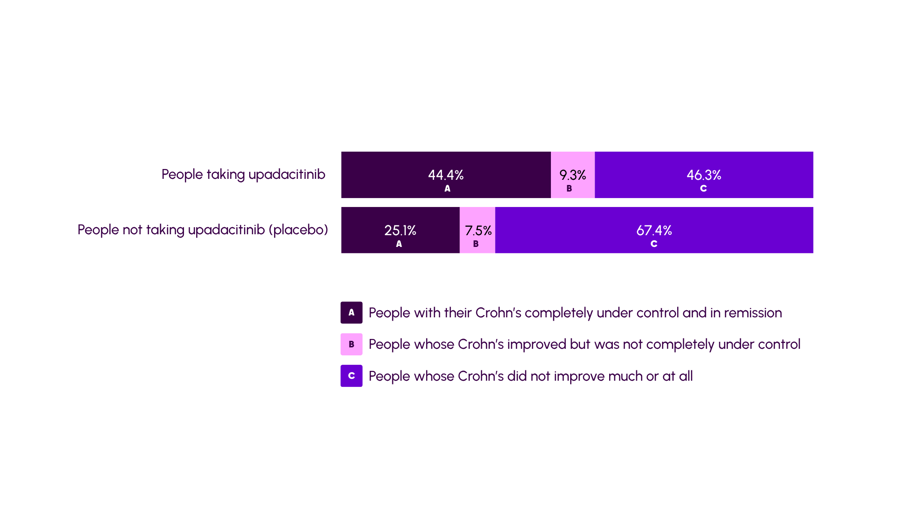
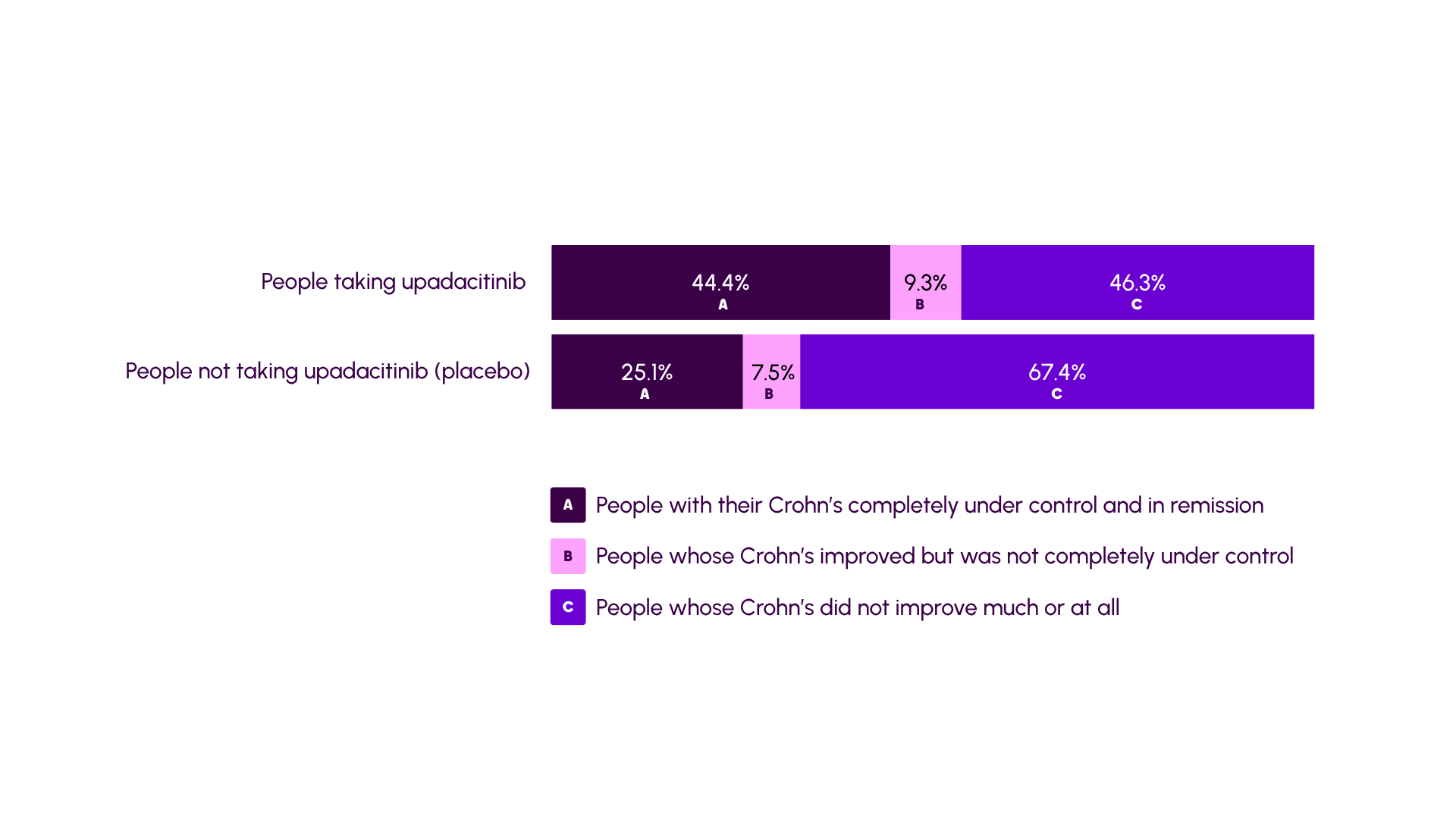
    Two large clinical trials have looked at how effective upadacitinib is at getting Crohn’s under control. These involved 1,021 people. The trials compared upadacitinib to a placebo in people with moderately to severely active Crohn’s. All these people had been treated with either a standard treatment or a biologic medicine. These medicines had not worked or been right for them.

    After 12 weeks: 

    • More than 4 in 10, or 44% of people who took upadacitinib had their symptoms under control. For people who took placebo, around 3 in 10, or 25% had their symptoms under control.
    • Around 1 in 10, or 9% of people who took upadacitinib had some improvement in their symptoms. But their symptoms were not fully under control. For people who took placebo, this number was similar, with around 1 in 10 people, or 8% having some improvement.
    • Around 5 in 10, or 46% of people on upadacitinib, did not improve. For people who took placebo, around 7 in 10, or 67% did not improve. 

    The clinical trials showed that more people who took upadacitinib had their Crohn’s under control at 12 weeks, compared with people taking a placebo. But upadacitinib did not work for everyone. Some people who did not respond after 12 weeks may have responded with more doses of upadacitinib. 

    The chart below shows the data from these clinical trials. 

    View a larger image of this chart.

    People taking upadacitinib were also more likely than people taking placebo to have:

    • Less loose poo, known as diarrhoea
    • Less tummy pain
    • Less fatigue
    • Better quality of life

    Keeping Crohn’s under control

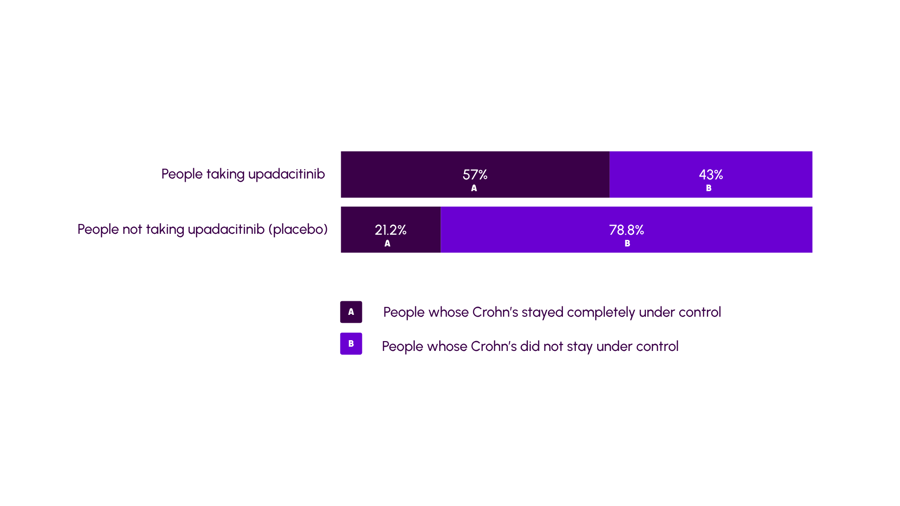
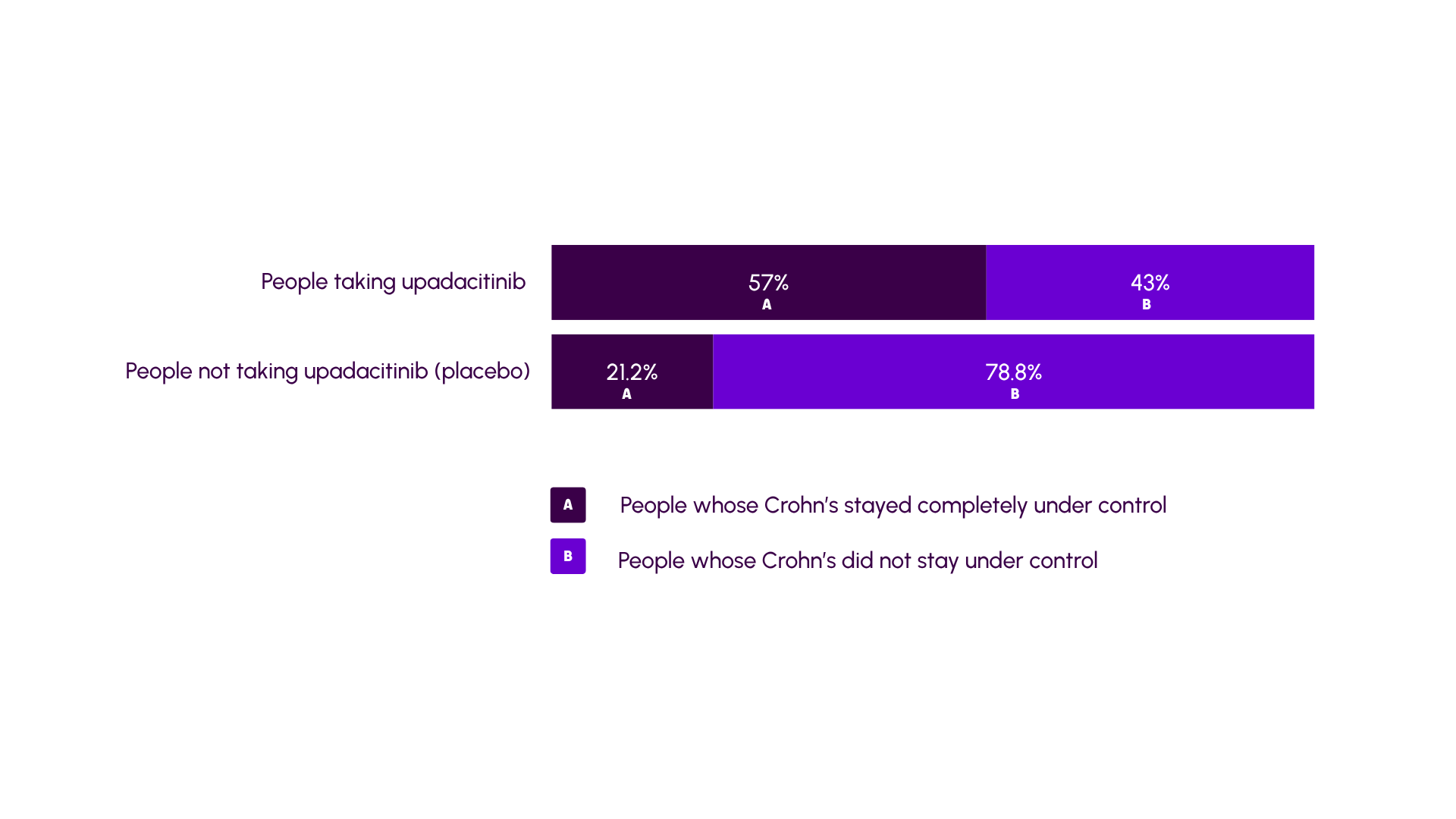
    Another clinical trial looked at how effective upadacitinib was at keeping Crohn’s under control. This trial used people who had responded to 12 weeks of upadacitinib treatment and whose symptoms were under control. In the trial, some of them carried on taking upadacitinib, while others were switched to a placebo. 

    After another 52 weeks of treatment with upadacitinib, around 6 in every 10 people, or 57% were still under control. Of those who took a placebo, around 2 in every 10 people, or 21% were still in remission. 

    The clinical trials showed that more people kept their Crohn’s under control with upadacitinib compared to a placebo. But upadacitinib did not carry on working for everyone. 

    The chart below shows the data from these clinical trials. 

    View a larger image of this chart.

  • Upadacitinib can be effective at improving your symptoms and keeping your Ulcerative Colitis under control. But it does not work for everyone. Different medicines work for different people, and it may take time to find the medicine that is right for you.

    Understanding clinical trial results

    The information below shows the results of clinical trials. Clinical trials are used to test a medicine is safe and see how well it works. To find this out, scientists compared people who took upadacitinib with people who took a placebo. A placebo looks the same as the treatment but does not have any medicine in it.

    The results below show what happened in the people who took part in the studies. Your experience may be different. This is because clinical trials do not always reflect real life. Many things can affect how well a medicine works, and everyone is different

    You can find out more about clinical trials in our information on talking about the effectiveness of medicines. 

    Getting Ulcerative Colitis under control

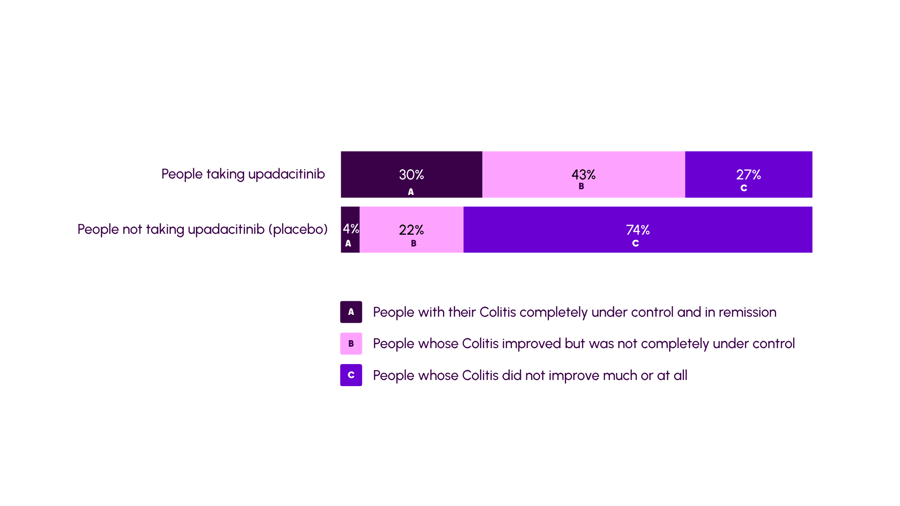
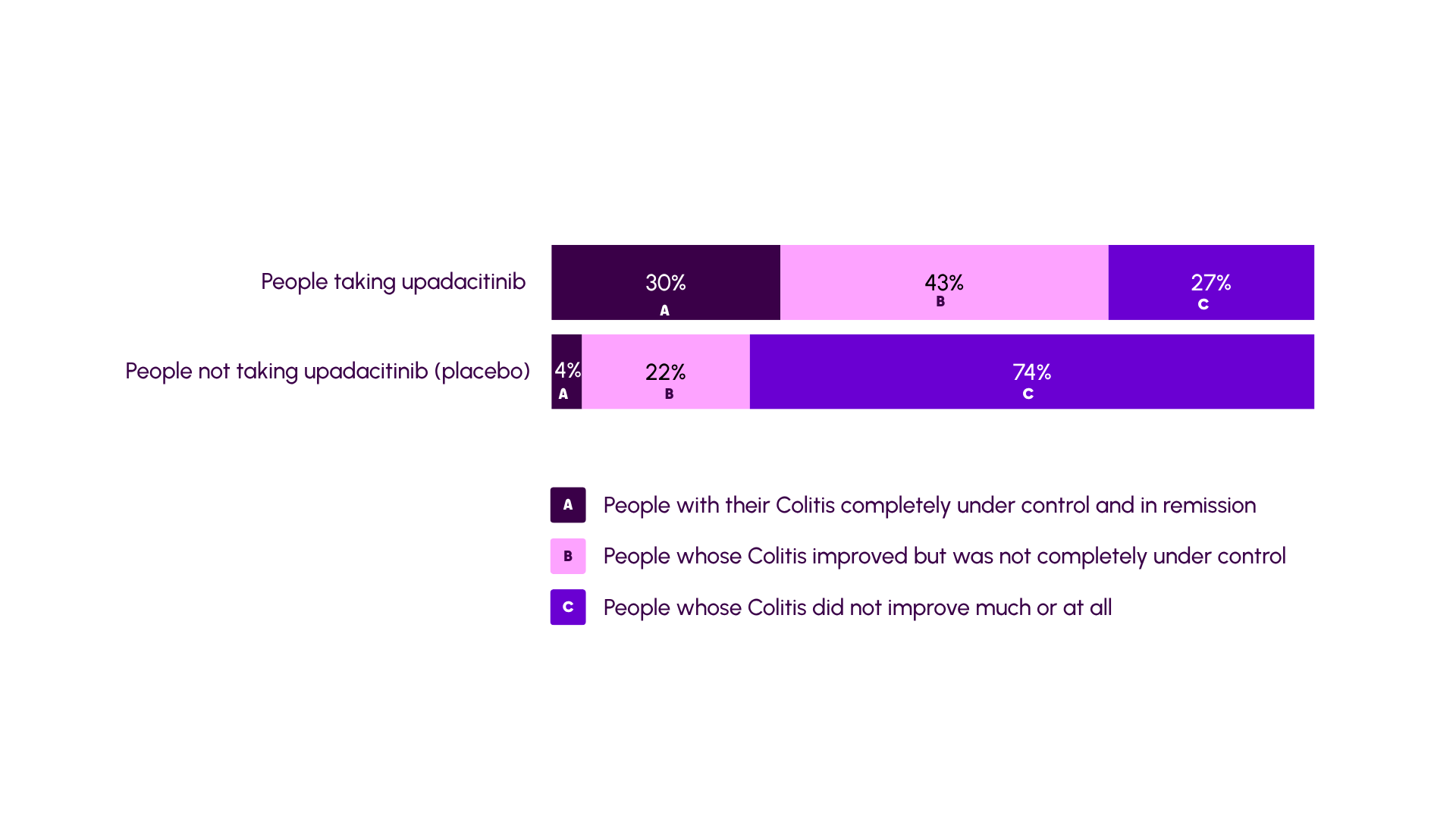
    Three large clinical trials have looked at how effective upadacitinib is at getting Crohn’s under control. The trials compared upadacitinib to a placebo in people with moderately to severely active Ulcerative Colitis. All these people had been treated with either a standard treatment or a biologic medicine. These medicines had not worked or been right for them.

    After 8 weeks: 

    • 3 in 10, or 30% of people who took upadacitinib had their symptoms under control. For people who took placebo, less than 1 in 10, or 4% had their symptoms under control.
    • Around 4 in 10, or 43% of people who took upadacitinib, had some improvement in their symptoms but were not fully under control. For people who took placebo, around 2 in 10 people, or 22% had some improvement.
    • Around 3 in 10, or 27% of people on upadacitinib, did not improve. For people who took placebo, around 7 in 10, or 74% did not improve. 

    The clinical trials showed that more people on upadacitinib had their Ulcerative Colitis under control after 8 weeks, compared with people taking a placebo. But upadacitinib did not work for everyone. Some people who did not respond after 8 weeks may have responded with more doses of upadacitinib. 

    The chart below shows the data from these clinical trials. 

    View a larger image of this chart.

    People taking the recommended dose of upadacitinib were also less likely than people taking placebo to have:

    • An urgent need to go for a poo
    • Tummy pain
    • Bleeding from their bottom
    • Loose poo, known as diarrhoea
    • Fatigue

    Keeping Ulcerative Colitis under control

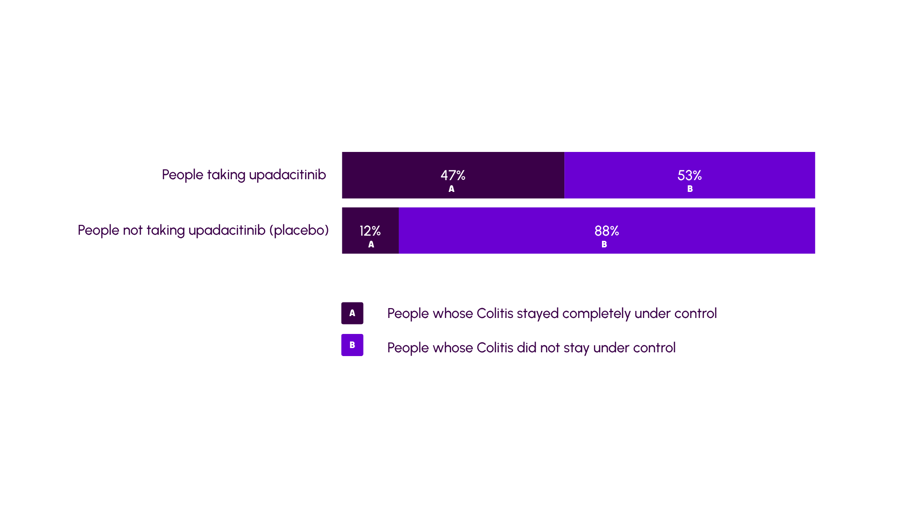
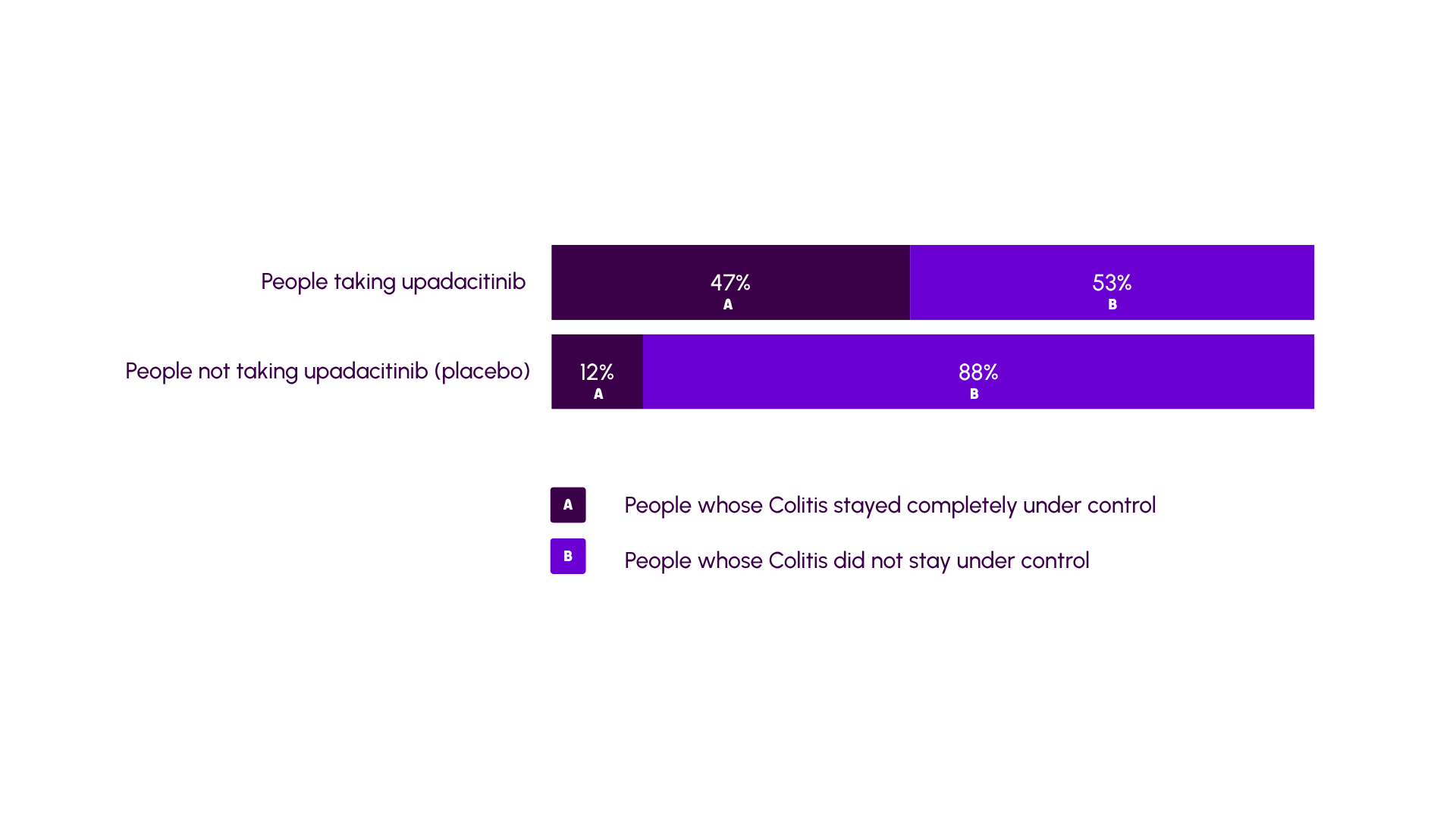
    Another clinical trial looked at how effective upadacitinib was at keeping Ulcerative Colitis under control. This trial used people who had responded to 8 weeks of upadacitinib treatment and had symptoms under control. In the trial, some of them carried on taking upadacitinib, while others were switched to a placebo. 

    After another 52 weeks of treatment with upadacitinib, around 5 in every 10 people, or 47% were still had their symptoms under control. Of those who took a placebo, around 1 in every 10 people, or 12% were still in remission. 

    The clinical trials showed that more people kept their Ulcerative Colitis under control with upadacitinib compared to a placebo. But upadacitinib did not carry on working for everyone. 

    The chart below shows the data from these clinical trials.

    View a larger image of this chart.

  • Everyone responds differently to a new medicine. Some people taking upadacitinib start to feel better within a few days of starting treatment. Many people start feeling better between 2 and 8 weeks. But some people might not feel better at all.

    It can be difficult waiting to see whether a new medicine works for you. You can still ask for help and support during this time. If you need support or become more unwell, contact your GP or IBD team. Our helpline service may also be able to signpost you towards the help you need.

    “”

    Before this treatment, everything revolved around managing flare ups, now we are able to focus on living life again.

    If upadacitinib does not help to control your symptoms, your IBD team might talk to you about changing your dose. If this does not work, they might recommend you stop it and try a different treatment. For more information, see our section on stopping or changing treatment

  • Upadacitinib is a tablet that you take once a day. The tablets are available in doses of:

    • 15mg
    • 30mg
    • 45mg 

    Tips on taking upadacitinib:

    • Try to take the tablet at a similar time each day. This can help you remember when to take it.
    • Swallow the tablet whole with a drink of water.
    • Do not split, crush or chew the tablet because it could change how well it works for you.
    • You can take upadacitinib with or without food.
    • Avoid foods or drinks that contain grapefruit while you are on upadacitinib. These can affect how your body deals with upadacitinib.
    • If you miss a dose, take it when you remember later that day. But if you miss a whole day, do not take a double dose to make up for it. Just skip the missed dose.
    • You may notice parts of your tablet in your poo. Or, if you have a stoma, in your ostomy output. If you do, let your IBD team know. Not fully digesting your tablet may affect how well upadacitinib works for you.

    What dose to take for Crohn’s

    Your IBD team will tell you what dose is suitable for you. During your treatment, they may increase or decrease your dose depending on how you respond to your medicine.

    • Starting dose: Most people start at a dose of 45mg once a day for 12 weeks. You might start on a lower dose if:
      • You have serious kidney disease
      • You’re taking medicines that could interact with upadacitinib.
    • Ongoing dose: After 12 weeks, if you have responded to treatment, you will drop down to 15mg or 30mg once a day. The aim is to take the lowest dose that keeps your condition under control. If going down to 15mg does not work well, you may be able to go back up to 30mg.
    • Ongoing lower dose: You may be given 15 mg once a day if:
      • You are 65 years old or older
      • You have a higher risk of:
        • Heart attack
        • Stroke
        • Blood clots
        • Cancer
    • If upadacitinib does not work for you: If your symptoms do not get better after the first 12 weeks, your IBD team may suggest trying for a bit longer. You may be given 30mg once a day for another 12 weeks. If this does not help, you may need to stop upadacitinib and try a different treatment option.

    What dose to take for Ulcerative Colitis

    Your IBD team will tell you what dose is suitable for you.

    • Starting dose: Most people start at a dose of 45mg once a day for 8 weeks. You may start on a lower dose if:
      • You have serious kidney disease
      • You’re taking medicines that could interact with upadacitinib
    • Ongoing dose: After 8 weeks, if you have responded to treatment, you may drop down to either 15mg or 30mg once a day. The aim is to take the lowest dose that keeps your condition under control.
    • Ongoing lower dose: You may be given 15 mg once a day if:
      • You are 65 years old or older
      • You have a higher risk of
        • Heart attack
        • Stroke
        • Blood clots
        • Cancer
    • If upadacitinib does not work for you: If your symptoms do not get better in the first 8 weeks, your IBD team may suggest trying for a bit longer. You may be given 45mg once a day for another 8 weeks. If this does not help, you may need to stop upadacitinib and try a different treatment option.
  • Reading about side effects may make some people feel anxious. Knowing the risks of any medicine you take is important. But it's also important to balance these with the benefits as well. Remember that many people find that upadacitinib helps them. But it may not be suitable for everyone. If you have any questions or worries about your medicine, talk to your IBD team.

    How side effects may affect you

    All medicines can have side effects, but not everyone experiences them. In most clinical trials, the risk of getting side effects was similar in people taking upadacitinib to people not taking upadacitinib.

    Having certain side effects might mean that upadacitinib is not right for you. Side effects can affect people in different ways:

    • They may happen right away. Others may happen after you have been taking upadacitinib for a while.
    • They may be mild. Others may be more serious and could need treatment.
    • They may go away on their own. Others may go away after you stop taking upadacitinib. Some may be long-lasting.
    • Some side effects may happen when you are on a higher dose of upadacitinib. These may improve if your IBD team lower your dose.

    Speak to your IBD team if you experience any side effects.

    You will have regular tests before and during treatment with upadacitinib to check for certain side effects. We have more on this in tests and checks for side effects

    Very common side effects

    These can affect more than 1 in 10 people taking upadacitinib, and include:

    • Throat and nose infections
    • Spots, known as acne

    Common side effects

    These can affect up to 1 in 10 people taking upadacitinib, and include:

    • Some types of Infections. See our infections section below.
    • Cough.
    • Non-melanoma skin cancer.
    • Shingles. This is a painful rash caused by the chicken pox virus.
    • High temperature.
    • Feeling sick, known as nausea.
    • Putting on weight.
    • Tummy pain.
    • Fatigue.
    • Headache.
    • A rash or an Itchy, raised rash, known as hives.
    • Feeling dizzy.
    • A spinning feeling, known as vertigo.
    • Swelling of the feet or hands, known as peripheral oedema.

    If you experience dizziness or vertigo, you should not drive, use heavy machinery or sign legal documents until the feeling goes away.

    Find out more in our section on lowering risks of side effects.

    Possible serious side effects

    Some people might get serious side effects that need urgent treatment. These do not happen often, but it is important to know what to look out for. 

    Allergic reaction

    Up to 1 in every 100 people taking upadacitinib might have a serious allergic reaction.

    Call 999 or get emergency medical help if you have a severe allergic reaction. Symptoms of this usually appear soon after taking the medicine.

    Signs to look out for include:

    • Difficulty breathing or swallowing
    • Feeling very dizzy or light-headed
    • Swelling of your face, lips, tongue, mouth or throat
    • A rash or raised, itchy patches on your skin, known as hives

    If you have a severe allergic reaction, you should stop taking upadacitinib and contact your IBD team to tell them what happened.

    Infections

    Upadacitinib affects your immune system, so your body might not fight off infections as well as it used to. You might get more infections than you used to. Or they might last longer or be more serious than usual. You may be more likely to have infections if you are 65 years or older.

    The more common types of infection are:

    • Flu.
    • Cold sores.
    • Swollen hair follicles, known as folliculitis
    • Urinary tract infections.
    • Lung infection. This is known as either bronchitis or pneumonia. The name of this type of infection will depend on where the infection is in your lung.  

    More rare types of infection may affect up to 1 in 100 people. These include:

    • Oral thrush. This is a fungal infection in the mouth.
    • Diverticulitis. This is an infection in small bulges or pouches that some people have in their bowel wall.
    • Blood infection, known as sepsis. 

    If you are worried about an infection, contact your GP or NHS 111. You will need to explain that you are taking upadacitinib. 

    Get urgent help if you have a serious infection. This may include:

    Shingles

    • A tingling or painful feeling on your skin
    • A headache
    • Feeling generally unwell

    Cold sores

    • Tingling, itching or burning feeling on a part of your face
    • A painful rash with blisters

    A lung infection, also known as pneumonia

    • A cough, sometimes with yellow or green phlegm
    • Being short of breath
    • A high temperature
    • Chest pain
    • An aching body
    • Feeling very tired
    • Wheezing
    • Feeling confused

    Blood infection, known as sepsis

    • Problems breathing or breathing fast.
    • Having a fit.
    • A high or low temperature.
    • Blue, grey, pale or blotchy skin, lips or tongue. On black or brown skin, this may be easier to see on the palms of your hands or soles of your feet.
    • A rash that does not fade when you press it.
    • Being sleepier than usual or having difficulty waking.
    • Not peeing for a long time.

    If you have a serious infection, also let your IBD team know. They may ask you to stop taking upadacitinib until you feel better.

    More information on side effects

    This is not a full list of side effects. There is information about less common side effects of upadacitinib in the Patient Information Leaflet. This is also called a Package Leaflet. It should be in the box with your medicine. You can also get it online: Patient Information Leaflet for upadacitinib.

    What to do if you have a side effect

    Let your IBD team know if you are worried about any possible side effects.

    You can report any side effects to the Medicines and Healthcare Products Regulatory Agency (MHRA). These allow them to record and check the side effects people experience. You can do this through the Yellow Card scheme online or by downloading the MHRA Yellow Card app. This helps collect safety information about medicines. 

    Some people may get side effects that have not previously been reported or listed in any information. It can be helpful to write down when you started taking a medicine and when any new symptoms begin. This may help you and your healthcare team work out if a new symptom could be a side effect. 

  • Once you have got used to upadacitinib, you should have regular check-ups with your IBD team. This is to check if upadacitinib is still right for you or if you need to change your dose or stop treatment. Your IBD team should tell you what tests you’ll have and when you need them. 

    Your IBD team should:

    • Ask about your symptoms
    • Ask if you have had any side effects
    • Check for signs of infection

    They may also carry out blood tests. These can check:

    • Your levels of red and white blood cells.
    • Your cholesterol levels.
    • How well your liver is working.
    • Your levels of creatinine kinase. This is a protein in your body. Creatine kinase levels may increase after exercise, such as running or cycling, Try to avoid exercising before having your blood tests.

    Even if upadacitinib works well for you, it’s important to go to your check-up appointments. This is because your IBD team can check if you have any early signs of possible side effects. 

    Some people may need to travel to a particular clinic or hospital to have these tests. This can be difficult, even though these checks are important. Talk to your IBD team if travel is an issue for you.  

  • Everyone is different, and you may not be able to avoid every side effect from upadacitinib. But there are things you may be able to do to lower some risks or how you are affected. 

    Carry around your patient card

    When starting upadacitinib, you might be given a patient reminder card. This may also be known as a patient alert card or a patient card. This contains important safety information about upadacitinib. 

    In an emergency, this card can help healthcare professionals to quickly know about your medicine. 

    You should show this card to any doctor, dentist or healthcare professional who treats you. Always carry this card with you while you are taking upadacitinib. 

    Preventing infections

    Upadacitinib can affect your immune system. This can increase your risk of getting serious infections. Our immunosuppressant precautions information gives you tips on lowering your risk of getting an infection. These include:

    • General hygiene
    • Storing and preparing food safely
    • Travelling abroad
    • Cosmetic procedures
    • Animal interactions
    • Open water swimming

    Staying up to date with vaccinations

    • You should not have live vaccines while you are taking upadacitinib.
    • If you have had a live vaccine, you should wait 4 weeks before starting upadacitinib.
    • You may have to wait for 3 months after finishing upadacitinib before you have a live vaccine.
    • You can have non-live vaccines when you are on upadacitinib. But they might not work as well as they do in other people.

    Live vaccines are made using weakened versions of living viruses or bacteria. If you have a lowered immune system, there is a possibility that they might cause infections.

    Live vaccines used in the UK include:

    • BCG vaccine.
    • Chickenpox vaccine.
    • Measles, mumps and rubella (MMR) vaccine.
    • Nasal flu vaccine used in children. The injected flu vaccine used in adults is not live.
    • Rotavirus vaccine.
    • Yellow fever vaccine.
    • Oral typhoid vaccine. The injected typhoid vaccine is not live.

    If anyone in your family or household is due to have a live vaccine, check with your IBD team whether you need to take any special precautions.

    Your IBD team should check that your vaccinations are up to date before you start treatment with upadacitinib. This may include vaccines for: 

    • Shingles. Both doses of this vaccine should be offered to anyone over 18 years old who is on upadacitinib.
    • Chickenpox.
    • BCG.

    Everyone with Crohn’s or Ulcerative Colitis taking a medicine that alters the immune system should be invited to have the flu vaccine every year. You may be advised to have the pneumococcal vaccine. You are also eligible for COVID-19 vaccinations. These are not live vaccines, and it is safe to have them while you are taking upadacitinib.

    Avoid certain foods

    While you’re on upadacitinib, you should avoid:

    • Grapefruit
    • Food that contains grapefruit
    • Grapefruit juice 

    This is because it may increase the amount of upadacitinib in your body. This may increase your risk of side effects.

    Lowering your risk of cancer

    Upadacitinib may increase your risk of some cancers. Although these cancers may not affect most people, reading about cancer may be worrying or make you feel anxious. You may have questions or concerns about whether this treatment is right for you. Your IBD team should be able to support you with these and can talk to you about your risk of cancer.

    Non-melanoma skin cancer

    Taking Upadacitinib may increase your risk of certain types of skin cancer. These are known as non-melanoma skin cancers. They can affect up to 1 in 10 people taking upadacitinib.

    Non-melanoma skin cancer is usually easy to treat. But, to keep you safe, your healthcare professional should carry out regular checks to look for any changes to your skin. For virtual appointments, you may be asked to use a phone camera to show your skin. 

    If you notice any changes to your skin that you are concerned about, contact your GP.

    The NHS website has more information about non-melanoma skin cancer, including signs to watch out for.

    Other types of cancer

    In theory, upadacitinib may slightly increase your risk of getting other types of cancers. This is because a medicine that works in a similar way has been linked to an increased risk of cancer. At the moment, there is not enough evidence to know about upadacitinib for sure. In some studies, cancers were rare, but we need results from longer-term studies to understand any risk.

    To lower your own risk of cancer, it is a good idea to:

    • Go to any routine cancer screening you’re invited to.
    • Contact your GP if you notice any changes to your body that you are worried about. The NHS website has information on symptoms to watch out for.
    • Practice good sun safety. This includes:
      • Wearing a hat
      • Using high-factor sunscreen
      • Staying in the shade
      • Avoiding indoor UV sunbeds

    The NHS website has more tips for staying safe in the sun.

    Recognising signs of blood clots

    It’s possible that upadacitinib may increase your risk of blood clots in your legs or your lungs. This is because some medicines that work in a similar way had this effect.  We do not know yet if there is an increased risk for people with Crohn’s or Ulcerative Colitis taking upadacitinib. 

    Your IBD team should ask if you have had blood clots before you start treatment.
    The NHS website has more information about blood clots.

    It’s important to know the signs of a blood clot. Recognising these symptoms could help you get treatment as soon as possible.

    Get medical help straight away if you notice any of the signs below. 

    Signs of blood clots can include:

    • Breathlessness.
    • Chest pain.
    • Throbbing pain. This is usually in the calf or thigh when you walk or stand.
    • Swelling in one leg, or more rarely, both legs.
    • Warm skin around the painful area.
    • Red or darkened skin around the painful area. This may be harder to see on brown or black skin.
    • Swollen veins that are hard or sore when you touch them.

    Some of these symptoms can also happen in your arm or tummy.

    Recognising signs of heart attack and stroke

    It’s possible that upadacitinib may increase your risk of heart attack or stroke. This is because some medicines that work in a similar way had this effect. We do not know yet if there is an increased risk for people with Crohn’s or Ulcerative Colitis taking upadacitinib. 

    The NHS website has more information about heart attack and stroke.

    Call 999 straight away if:

    •  You have chest pain. This might feel tight or like squeezing on your chest. It may spread to your arms, neck or jaw.
    • You're having problems breathing. This might include gasping, choking or not being able to get words out.
    • Your lips or skin are pale, blue or grey. On brown or black skin, this may be easier to see on the palms of the hands.
    • Your face becomes weak. One side of your face may droop, and it might be hard to smile.
    • You have arm weakness. You may not be able to fully lift both arms and keep them there because of weakness or numbness in 1 arm.
    • You have speech problems. This may include slurring your words or sounding confused.

    Know the signs of diverticulitis

    Upadacitinib may increase your risk of diverticulitis. This is an infection in small bulges or pouches that some people have in their bowel wall.

    It’s important to know the signs of diverticulitis. Recognising these symptoms could help you get treatment as soon as possible. The symptoms of diverticular disease and diverticulitis can be similar to the signs of Crohn’s or Ulcerative Colitis. They can include:

    • Tummy pain, usually on the left side, but not always. This may get worse after you eat and get better after you poo or fart.
    • Constipation.
    • Diarrhoea.
    • Bloating.

    The NHS has more information on diverticulitis.

    Contact your GP or NHS 111 if you notice the symptoms of diverticular disease and they are unusual for you or more severe than usual.

    Get urgent medical help if you:

    • Have blood or mucus in your poo
    • Have a high temperature, or feel hot, cold or shivery
    • Have tummy pain that gets worse or does not go away
    • Keep being sick for more than 2 days and cannot keep fluids down
    • Have diarrhoea for more than 7 days 
  • If you take other medicines at the same time as upadacitinib, or plan to take them, it’s important to check whether they’re safe. These may include other medicines for Crohn’s or Ulcerative Colitis, as well as medicines for any other condition you may have. 

    Taking upadacitinib with other Crohn’s and Ulcerative Colitis treatments

    Your IBD team should talk to you about whether you need to take other medicines. 

    It is safe to take upadacitinib alongside steroids or aminosalicylates (5-ASAs).

    If you are on steroids when you start upadacitinib, and respond well to treatment, you should be able to gradually stop taking the steroids. Your IBD team should talk to you about this.

    Do not stop steroids without talking to your IBD team. Stopping steroids suddenly may cause withdrawal symptoms.

    You should avoid taking upadacitinib with other medicines that affect your immune system. These include azathioprine and mercaptopurine.

    We do not know if upadacitinib is safe to take with other medicines that affect your immune system. These include biologic medicines and other JAK inhibitors. Clinical trials are needed.

    Other medicines

    Some medicines can affect how upadacitinib works. These include:

    • Some antibiotics, like rifampicin and clarithromycin.
    • Medicines used to treat fungal infections, like ketoconazole, itraconazole, posaconazole and voriconazole.
    • Phenytoin. This is a medicine used to treat epilepsy.

    This may not be a full list. Speak to your doctor or pharmacist if you’re taking, or plan to take, any other medicines. This includes:

    • Prescribed medicines
    • Over-the-counter medicines, such as cold or flu medicines
    • Multi-vitamins or supplements
    • Herbal, complementary or alternative therapies 
  • There is no evidence that drinking alcohol affects the way your body deals with upadacitinib.

    Just like everyone else, you should follow NHS guidelines on counting your weekly alcohol units. This can help keep your general health risks low. The NHS recommends not to drink more than 14 units of alcohol a week, on a regular basis.

    Many people with Crohn’s or Colitis say that alcohol makes their symptoms worse. At the moment, there is not enough high-quality evidence to know for certain if drinking alcohol could increase your risk of a flare-up.

  • How long to take upadacitinib

    Your IBD team should review your treatment regularly to check whether it’s still the best option for you. If you or your IBD team feel that it is no longer right for you, you should discuss other treatment options together.

    How long upadacitinib may stay in your body

    After you stop taking upadacitinib, it should mostly be out of your body by 45 to 70 hours. This is around 2 to 3 days.

    When to stop or change treatment

    Do not stop taking upadacitinib without discussing it with your IBD team or another healthcare professional.

    There are a few reasons why you or your IBD team might think about stopping or changing your treatment:

    • Your Crohn’s or Ulcerative Colitis is under control
      If your Crohn’s or Ulcerative Colitis stays under control for a year or more, you might be able to stop taking upadacitinib. If this is the case, your IBD team should discuss it with you, and you’ll make the decision together. You can tell them if you have any concerns about stopping. If you stop upadacitinib and you become unwell again, you should have the choice to start upadacitinib treatment again.
    • Upadacitinib has not worked
      If your condition has not got better after 16 weeks for Ulcerative Colitis or 24 weeks for Crohn’s, your IBD team are likely to suggest stopping upadacitinib and trying a different treatment option.
    • Upadacitinib stops working well
      It is possible that upadacitinib could stop working for you over time. If this happens, your IBD team might suggest stopping upadacitinib and trying another treatment.
    • You have side effects
      If you have side effects that are serious or hard to manage, stopping upadacitinib might be the best option for you.
  • Fertility

    We do not know if upadacitinib affects fertility in men or women.
    Studies in animals suggest that it does not. But its effect on human fertility has not been tested yet.

    If your periods start for the first time while you are taking upadacitinib, tell your IBD team.

    Read more about reproductive health and fertility when living with Crohn’s or Ulcerative Colitis.

    Contraception

    If you can get pregnant, you should use effective contraception while you are on upadacitinib. The manufacturers say that you should continue to use contraception for at least 4 weeks after you stop treatment. If you are thinking of trying for a baby, some guidelines recommend waiting for longer. See our information on planning pregnancy below.

    If you use hormonal contraception, tell your IBD team. Using hormonal contraception while taking upadacitinib may increase your risk of blood clots. Your IBD team should be able to tell you if you can take the 2 medicines together, or if you need to be on a different dose.

    Pregnancy

    • You should not take upadacitinib during pregnancy.
    • If you’re taking upadacitinib and you think you might be pregnant, tell your IBD team as soon as possible.

    There is very little information about the use of upadacitinib in pregnancy. But studies in animals suggest that it may harm unborn babies.

    Talk to your IBD team if you're pregnant or planning to get pregnant. They can discuss your treatment options with you.

    Read more about pregnancy and birth when living with Crohn’s or Ulcerative Colitis.

    Planning pregnancy

    If you are planning to get pregnant, speak with your IBD team as soon as possible. You should stop taking upadacitinib for 3 months before planning a pregnancy. This helps to make sure upadacitinib is no longer in your body. It will also give you time to review your treatment options and make sure your Crohn’s or Ulcerative Colitis is controlled as well as possible.

    Unplanned pregnancy

    Contact your IBD team straight away if you take upadacitinib and find out you are pregnant. If you cannot contact your IBD team, speak to your GP. Your GP may be able to help you contact your IBD team. 

    Do not stop taking your medicine until you have spoken to your healthcare professional.

    If you have taken upadacitinib during the early part of your pregnancy, always make sure you go to any scheduled prenatal scans.

    Read more about pregnancy and birth when living with Crohn’s or Ulcerative Colitis.

    Breastfeeding

    You should not take upadacitinib if you are breastfeeding.

    In studies on animals, upadacitinib passed into breastmilk. But we do not know whether this is true in humans.

    If you are thinking about breastfeeding, talk to your IBD team. They can help you decide whether to:

    • Stop upadacitinib while you are breastfeeding
    • Not breastfeed, so you can carry on taking upadacitinib

    Read more about postnatal care and breastfeeding when living with Crohn’s or Ulcerative Colitis.

  • If you have questions or concerns about your medicines, support is available.

    Your IBD team

    Contact your IBD team for advice about: 

    • Your treatment
    • Side effects
    • Symptoms
    • If you think your medicine is not working 

    They can help you decide what treatment is right for you.

    You may find it helpful to write down questions or symptoms before appointments. Our appointment guide can help you prepare for discussions with your IBD team.

    Your GP and local pharmacist

    Your GP or local pharmacist can answer questions about:

    • How to take medicines
    • Taking other medicines at the same time
    • Over-the-counter medicines

    Our Helpline

    We understand it can be challenging to manage your medicine. That’s why we’re here for you. Our Helpline can:

    • Support you understand the information you’ve been given
    • Listen to your questions and concerns
    • Help you find more information and support

    Medicine information

    All medicines come with a patient information leaflet. It explains how to take your medicine, possible side effects and other important safety information. You can also find patient information leaflets on the electronic medicines compendium website. 

  • We follow strict processes to make sure our information is based on up-to-date evidence and easy to understand. We produce it with patients, medical advisers and other professionals. It is not intended to replace advice from your own healthcare professional. 

    We hope that you’ve found this information helpful. Please email us at evidence@crohnsandcolitis.org.uk if:

    • You have any comments or suggestions for improvements
    • You would like more information about the sources of evidence we use
    • You would like details of any conflicts of interest

    You can also write to us at Crohn’s & Colitis UK, 1 Bishop Square, Hatfield, AL10 9NE, or contact us through our Helpline: 0300 222 5700.

    We do not endorse any products mentioned in our information.

Page
saved

This page has been saved in your personal space. Go to “My Page” to view all saved pages.

Helpline Service

Last updated: 22/07/2026

Our Helpline team can't take calls, chats or ring you back for the rest of the summer. But you can still reach us by email. 

If you need to contact the team, please email helpline@crohnsandcolitis.org.uk and we'll answer you as soon as possible. 

Thanks for bearing with us.

How Can We Help?

  • We can help you understand Crohn’s and Colitis
  • Listen and talk about living with IBD
  • Help you connect with others in the Crohn’s and Colitis community
  • Give you contact details of specialist organisations
  • We can support you to live well with Crohn’s or Colitis and provide up-to-date, evidence-based information

Please be aware we’re not medically or legally trained. We cannot provide detailed financial or benefits advice or specialist emotional support.

If you need specific medical advice about your condition, your GP or IBD team will be best placed to help.

Stay in the loop

Together, we’re making the greatest difference. Sign up to hear about the amazing things we’re achieving together.

Privacy Policy

© Crohn's & Colitis UK

Would you like to save the changes made to this page?