Guselkumab

Last full review: December 2025

Next review date: December 2028

Guselkumab

This information is for people with Crohn’s or Colitis who are taking guselkumab, also known as the brand name Tremfya. It is also for anyone who is thinking about starting guselkumab. Our information can help you decide if this treatment is right for you. It looks at:

  • How guselkumab works
  • What you can expect from the treatment
  • Possible side effects
  • Stopping or changing treatment

Where we use the term ‘Colitis’ in this information, we are referring to Ulcerative Colitis.  

This information might use words you have not heard before. Our page on medical words can help provide an explanation.

This information does not replace advice from your healthcare professional. Talk to your IBD team or read the leaflet that comes with your medicine for more details. You can also find out about guselkumab at medicines.org.uk. 

Download this information (PDF)

More Information

    • Guselkumab is also known by the brand name Tremfya , pronounced trem-fye-ah.
    • Guselkumab is used to treat adults who have moderately or severely active Crohn’s or Colitis.  
    • Guselkumab is usually an option if other treatments have not worked or have stopped working. You might also have it if other treatments have caused serious side effects or are not suitable for you.
    • Your first three doses are given as a drip into a vein or an injection under the skin. After your first three doses, the rest of your doses will be given as injections under the skin.
    • You may be more likely to get an infection while you are taking guselkumab. Contact your IBD team straight away if you think you have an infection.
    • It is safe to have the COVID-19 injection and yearly flu vaccines. But you should not have any live vaccines.
    • If you’re taking guselkumab and are pregnant or planning to get pregnant, talk to your IBD team. They can discuss your treatment options with you.
    • We do not know if guselkumab passes into breast milk. Talk to your IBD team if you are thinking about breastfeeding while taking guselkumab. 
  • Guselkumab is also known by the brand name Tremfya , pronounced trem-fye-ah.

  • Guselkumab is an interleukin inhibitor. Interleukins are proteins that have an important role in controlling your immune system. Your immune system is your body’s natural defence system. Guselkumab blocks interleukin-23 (IL-23). IL-23 has a key role in long-term inflammation in the gut. By blocking IL-23, guselkumab eases some of the inflammation that causes the symptoms of Crohn’s and Colitis.

  • Guselkumab is used to treat adults who have moderately or severely active Crohn’s or Colitis. Guselkumab is usually an option if other treatments have not worked or have stopped working. You might also have it if other treatments have caused serious side effects or are not suitable for you.

  • You may have been given a choice of taking guselkumab or another medicine. Our information on medicines for Crohn’s and Colitis can help you decide.  

    There are lots of things to think about when you start a new medicine. Your IBD team will talk to you about your options. For new medicines, you might want to think about the aim of the treatment and what the advantages and disadvantages might be. Some things to think about include: 

    • How you take it 
    • How well it works 
    • How quickly it works 
    • Possible side effects  
    • Whether you need ongoing tests or checks 
    • Other medicines you are taking 
    • Other conditions you have 
    • If you are planning to get pregnant or breastfeed in the next few years 
    • What happens if you do not take it 

    Treatment options that might be considered instead of guselkumab include other biologics and targeted medicines:

    You could use our medicine tool to help you think about your options. Our appointment guide has a list of questions you might want to ask your IBD team. We also have information on other medicinesorsurgery for Crohn’s or Colitis.

  • Guselkumab can be effective at improving symptoms and keeping Crohn’s under control. But it does not work for everyone. Different medicines work for different people, and it may take time to find the medicine that is right for you.

    Understanding clinical trials

    In clinical trials, people are given guselkumab, another medicine, or a placebo. A placebo is a substance that looks the same as the treatment but does not have any medicine in it. Comparing guselkumab to a placebo helps us see how well it works. You can find out more about clinical trials in our information on talking about the effectiveness of medicines. 

    For getting Crohn’s under control

    To get Crohn’s under control, guselkumab can be given as either:

    • An injection under the skin. This is known as a subcutaneous injection.
    • A drip into a vein. This is known as an intravenous, or IV, infusion.

    There have been three clinical trials that have looked at how well guselkumab can get Crohn’s under control. Two looked at how well intravenous infusions worked. One looked at how well subcutaneous injections worked. Everybody in the trials had tried another medicine before guselkumab. Some of them, but not all, had already tried biologic medicines.

    After 12 weeks of taking intravenous guselkumab, almost 5 in every 10 people, or 47%, were in remission. After 12 weeks of taking subcutaneous guselkumab, just over 5 in every 10 people, or 56%, were in remission.

    The results from these trials cannot be directly compared. This is because they were designed in a different way. This means we do not yet know whether one way of having this treatment is better than the other.

    For keeping Crohn’s under control

    These results come from two large trials, combined in one paper. Everybody in the trials had already been treated with Crohn’s medicines that had not worked or had stopped working. Some of them, but not all, had already tried biologic medicines.

    Most people will take 100mg of guselkumab every 8 weeks to keep their Crohn’s under control. A small amount of people will take 200mg every 4 weeks. Below we look at the data for people who took 100mg of guselkumab every 8 weeks.

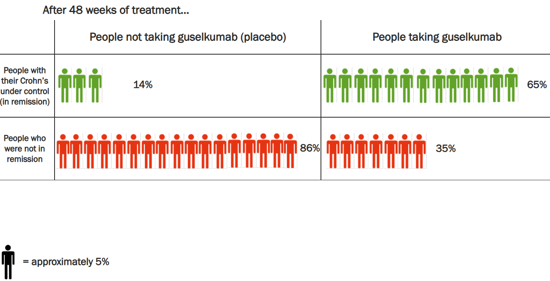
    A total of 286 people took guselkumab 100mg as an injection under the skin, and 148 people took placebo. The table below shows how many people were in remission after a total of 48 weeks of taking guselkumab.

    More people had their Crohn’s under control after taking guselkumab compared to people taking placebo. After 48 weeks of treatment, 65 in every 100 people who took guselkumab were in remission. Of the people who took placebo, 14 in every 100 were in remission.

  • Guselkumab can be effective at improving symptoms and keeping Colitis under control. But it does not work for everyone. Different medicines work for different people, and it may take time to find the medicine that is right for you.

    Understanding clinical trials

    In clinical trials, people are given guselkumab, another medicine, or a placebo. A placebo is a substance that looks the same as the treatment but does not have any medicine in it. Comparing guselkumab to a placebo helps us see how well it works. You can find out more about clinical trials in our information on talking about the effectiveness of medicines. 

    For getting Colitis under control

    To get Colitis under control, guselkumab can be given as either:

    • An injection under the skin. This is known as a subcutaneous injection.
    • A drip into a vein. This is known as an intravenous, or IV, infusion.

    There have been two clinical trials that have looked at how well guselkumab can get Colitis under control. One looked at how well intravenous infusions worked. One looked at how well subcutaneous injections worked. Everybody included in the trial had tried another medicine before guselkumab. Some of them, but not all, had already tried biologic medicines.

    After 12 weeks of taking intravenous guselkumab, around 6 in every 10 people, or 62%, showed some improvement. And just over 2 in every 10 people, or 23%, were in remission.

    After 12 weeks of taking subcutaneous guselkumab, just over 6 in every 10 people, or 66%, showed some improvement. Almost 3 in every 10 people, or 28%, were in remission.

    The results from these trials cannot be directly compared. This is because they were designed in a different way. This means we do not yet know if one way of having this treatment is better than the other.

    For keeping Colitis under control

    Most people will take 100mg of guselkumab every 8 weeks to keep their Colitis under control. A small amount of people will take 200mg every 4 weeks. Below we only look at the data for people who took 100mg of guselkumab every 8 weeks.

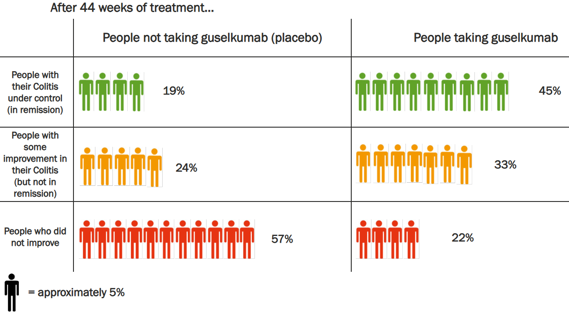
    These results come from one large clinical trial. It’s important to know that people could be included in this trial if their Colitis had shown improvement after 12 weeks of IV guselkumab treatment. 188 took guselkumab 100mg as an injection under the skin, and 190 took placebo. The table below shows how many people were in remission after a total of 44 weeks of taking guselkumab.

    More people had their Colitis under control after taking guselkumab compared to people taking placebo. After 44 weeks of treatment, 45 in every 100 people who took guselkumab were in remission. Of the people who took placebo, 19 in every 100 were in remission.

  • Everyone responds differently when taking a new medicine. Some people with Crohn’s start to feel better after taking guselkumab for 4 weeks. Some people with Colitis start to feel better after taking guselkumab for 2 weeks. But it may take longer, and some people might not respond at all.

  • You will have your first three doses of guselkumab as either:

    • A drip into a vein. This is called an intravenous, or IV, infusion.
    • An injection under your skin. This is known as a subcutaneous injection.

    The first three doses are called induction doses. Their aim is to get your Crohn’s or Colitis under control.  You will have one dose every four weeks. If you are having the injection, you will need two injections to get the full dose.

    After your first three doses, you will continue to have guselkumab as an injection under your skin.  You will have the injection either every four weeks or every eight weeks. How often you will have the injection depends on how well you respond and what dose you need. This aims to keep your Crohn’s or Colitis under control and is known as maintenance.

    Having the infusion

    You will have to go to hospital to have the infusion. You can often have it in a day unit, so you will only be there for a few hours. A doctor or nurse will give you the infusion through a drip into one of the veins in your arm. It takes at least one hour to have the dose. After this, the doctor or nurse should flush your drip through with a solution of saline. Saline is a mix of salt and water. This is to make sure that all the guselkumab goes into your vein, and none is left in the drip. The flush should not be painful, but it may feel a bit cold.

    After your infusion, your doctor or nurse will probably keep you for up to one hour. This is to make sure that you are not having a reaction to the infusion. 

    Having the injection

    Guselkumab injections come ready to use in a pre-filled injection pen. You may decide with your IBD team to inject yourself at home. But some people may have their injections in hospital. If you are going to have it at home, you will need to learn how to inject yourself. Someone from your IBD team or home delivery team will teach you how to do this. If you prefer, it may be possible for them to teach someone else to give you the injections.

    Delivery 

    Your hospital may arrange for a special delivery company to send your guselkumab injections to your home. Guselkumab can only be prescribed by a specialist in the hospital. It is not a medicine that your GP can prescribe for you to pick up from your local pharmacy.

    Storage

    Keep guselkumab injections in the fridge, between 2°C and 8°C. Do not freeze your pre-filled pen. Keep them in the original carton to protect them from light. Do not leave the pens in direct sunlight.

    Tips on injecting

    You may feel pain at the injection site. You may also get redness, itching and swelling.  These tips can help make injecting easier to manage:

    • Let your medicine warm to room temperature
      Take your injection out of the fridge about 30 minutes before you inject. This means it can warm to room temperature. Do not warm the injection in any other way, such as in hot water or a microwave.
    • Apply an ice pack before you inject
      You might find it helpful to apply an ice pack to the injection area for two to three minutes before you inject. If you do this, put a thin towel under the ice pack or wrap it in a cloth so it does not damage your skin.
    • Choose your injection site
      The upper thigh or tummy, away from the belly button, are good places for the injection. Avoid any areas where the skin is red, scarred, bruised or hard. Do not use the same place every time.
    • Wash your hands and clean the skin at the injection site
      Wash your hands with soap and water. Make sure the skin at the injection site is also clean before you inject. You can use an alcohol wipe to do this. This helps to lower the risk of infection.
    • Use a good injection technique
      Remove the cap and place the pen on the injection site at a 90° angle. Make sure you can see the window facing you on the pen. Press the pen down firmly onto the skin. When the injection starts, you’ll hear a click. After you hear a second click, continue to hold the pen down for the count of five.
    • Use an ice pack after you inject
      Some people recommend applying an ice pack or cold, damp towel to the area for 10 to 15 minutes after you have injected. This can help with pain at the injection site. Remember to put a thin towel under the ice pack or wrap it in a cloth.
    • Wear loose clothing.
      Wear loose clothing to avoid rubbing or pressure on the injection site.

    If you have problems injecting your guselkumab, ask your IBD team for help.

  • Your IBD team will review your treatment regularly to check whether it is still the best option for you.

  • Your IBD team may think it is right to stop or change your treatment if:

    • Guselkumab is not working. Your IBD team might stop guselkumab if you have been taking it for five to six months with no signs of improvement.
    • You have a serious allergic reaction.

    You may also need to temporarily stop guselkumab if you have a serious infection that is not improving.

    You have a right to take part in decisions about your treatment. Tell your IBD team what matters most to you. This will help them give you the information and support you need. Our guide to appointments can help you have these conversations.

    Do not stop taking your medicine unless your IBD team say it is OK. If you stop taking this medicine, but are still unwell, you may be able to try a different biologic or other targeted medicine.

  • You may take guselkumab on its own or with other medicines for your condition. Other medicines that you might take with guselkumab include steroids, or immunosuppressant medicines like azathioprine or mercaptopurine.  It is safe to take guselkumab with these medicines. Always check with your IBD team which medicines you should be taking.

    If you are taking steroids when you start guselkumab, you might be able to stop them. Your IBD team will discuss this with you. It is important that you do not stop taking steroids without speaking to your IBD team.

  • Infections

    You should not start guselkumab if you have an infection. Talk to your IBD team if you have signs of an infection before starting guselkumab.

    Signs of an infection can include:

    • A high temperature
    • Flu-like symptoms
    • Muscle aches
    • Cough
    • Shortness of breath
    • Burning when you pee, or peeing more than usual

    Tuberculosis (TB)

    Your IBD team will check for tuberculosis, also known as TB, before you start guselkumab. If you have a history of TB, your IBD team may give you anti-TB treatment before you start guselkumab.

    Hepatitis

    Your IBD team will also check for hepatitis before you start guselkumab.

    Blood tests

    Before starting guselkumab, you may have some blood tests. These could include liver function tests. Some people who take guselkumab develop changes in liver enzymes. Your IBD team might check your liver enzymes before starting treatment.

    Vaccines

    Your IBD team may also ask about any vaccines you have had. This is to make sure that your vaccines are up to date before you start guselkumab. Let them know if you are going to have any vaccines, or you have had any vaccines recently.

  • Blood tests

    These may include liver function tests. Some people who take guselkumab develop changes in liver enzymes. Your IBD team might check your liver enzymes during treatment.

    Other checks

    Your IBD team will check how well guselkumab is working. You may need to have a camera put into your mouth or bottom, called an endoscopy. You might also need a poo test, called a faecal calprotectin test.

  • Guselkumab can affect the way your immune system works. You may be more likely to get an infection while you are taking guselkumab. Signs of an infection can include:

    • A high temperature
    • Flu-like symptoms
    • Muscle aches
    • Cough
    • Shortness of breath
    • Burning when you pee, or peeing more than usual

    Contact your IBD team if you have signs of an infection.

    Even though your risk of infection may be greater, it should not stop you from living life as before. See our information on immunosuppressant precautions to find out some practical things you can do to lower your risk.

  • All medicines can have side effects, but not everyone gets them. Having certain side effects might mean that guselkumab is not right for you.  

    • Some side effects can happen right away. Others may happen after you have been taking guselkumab for a while. 
    • Some side effects are mild. Others may be more serious and could need treatment.  
    • Some side effects may go away on their own. Others may go away after you stop taking guselkumab. Some may be long-lasting.  

    Speak to your IBD team if you experience any side effects.

    Very common


    Can affect more than 1 in 10 people


    • Chest infections

    Common


    Can affect between 1 and 10 in every 100 people


    • Headache
    • Diarrhoea
    • Rash
    • Joint pain
    • Increased liver enzyme levels in blood tests

    Uncommon


    Can affect between 1 and 10 in every 1,000 people

    • Reactivation of viruses leading to herpes or shingles
    • Fungal infections
    • Inflammation of the stomach
    • Raised itchy patches on your skin, known as hives
    • Reactions at the injection site
    • Lower levels of a type of blood cell called neutrophils

    This is not a full list of side effects. For more information see the Patient Information Leaflet that comes with your medicine. You can also download the leaflet by searching for ‘guselkumab’ on the Electronic Medicines Compendium (EMC).  

    Because guselkumab is a new medicine there is not a lot of evidence on long-term side effects. We encourage you to report any side effects to the Medicines and Healthcare Products Regulatory Agency (MHRA). You can do this through the Yellow Card scheme online or by downloading the MHRA Yellow Card app (yellowcard.mhra.gov.uk). This helps collect important safety information about medicines. 

    Allergic reactions

    Some people may be allergic to the ingredients in guselkumab.

    Signs of a severe allergic reaction include:

    • Your lips, mouth, throat or tongue suddenly becoming swollen 
    • Your throat feeling tight 
    • Struggling to breathe, or breathing very fast 
    • Becoming very confused, drowsy or dizzy 
    • Fainting and not being able to be woken up 
    • A swollen, raised or itchy rash 

    Call 999 if you think you are having a severe allergic reaction. 

  • Guselkumab is not currently known to interact with any other medicines. Speak to your doctor or pharmacist if you are taking, or plan to take, any other medicines. This includes:

    • Prescribed medicines
    • Over-the-counter medicines that you buy from a pharmacy or supermarket
    • Multi-vitamins or supplements
    • Herbal, complementary or alternative medicines
  • If possible, make sure that you are up to date with your vaccines before you start treatment with guselkumab.

    Live vaccines

    Live vaccines contain weakened live strains of viruses or bacteria. You should not have live vaccines while taking guselkumab. You should also not have live vaccines for at least 12 weeks after stopping guselkumab. This is because the weakened virus could reproduce too much and cause a serious infection.

    If you have recently had a live vaccine, you might need to wait 12 weeks before starting guselkumab.

    In the UK, live vaccines include: 

    • Rotavirus vaccine. This is given to babies only.
    • Measles, mumps and rubella. This may be given as the triple MMR vaccine.
    • Nasal flu vaccine. The injected flu vaccine is not live.
    • Chicken pox vaccine. This is also known as varicella
    • BCG vaccine against tuberculosis, or TB.
    • Yellow fever vaccine.
    • Oral typhoid vaccine. The injected typhoid vaccine is not live.
  • Fertility 

    The effect of guselkumab on human fertility has not been studied. In animal studies, no effects were seen.

    If you can get pregnant, you should use effective contraception while taking guselkumab. You should also use effective contraception for at least 12 weeks after you stop taking guselkumab.

    Planning a pregnancy

    We do not know how guselkumab might affect pregnancy. In animal studies, no harmful effects were seen. But to be safe, it is generally recommended that guselkumab is not used during pregnancy.

    Speak to your IBD team if you are offered or are taking guselkumab and want to start a family. They can help you make an informed decision about your care and your baby's safety.

    If you have an unplanned pregnancy

    Contact your IBD team straight away if you are taking guselkumab and find out that you are pregnant. Do not stop taking your medicine without speaking to a healthcare professional.

    For more information, you might find our resources on pregnancy and birth and reproductive health useful. 

  • We do not know if guselkumab passes into breast milk.

    Speak to your IBD team if you are taking guselkumab and want to breastfeed. They can help you make an informed decision about your care and your baby's safety. We have more information on breastfeeding in our postnatal care and breastfeeding resource. 

  • There is currently no evidence on if it is safe to drink alcohol while taking guselkumab. Talk to your IBD team about the risks of drinking alcohol while taking guselkumab.

  • Taking medicines and managing side effects can be difficult – we understand and we’re here to help. Our Helpline can answer general questions about treatment options and can help you find support from others with the conditions. Your IBD team are also there to help. You can talk to them about your dosage, how they’ll be monitoring you and what other options there might be. You should also get in touch with your IBD team if you have any new symptoms or side effects. It can take time to find the medicine that’s right for you. Do not be afraid to ask questions and seek out extra support when you need it. This information is general and does not replace specific advice from your health professional. Talk to your GP or IBD team for information that’s specific to you.

  • We follow strict processes to make sure our information is based on up-to-date evidence and is easy to understand. We produce it with patients, medical advisers and other professionals. It is not intended to replace advice from your own healthcare professional.

    We hope that you’ve found this information helpful. Please email us at evidence@crohnsandcolitis.org.uk if:

    • You have any comments or suggestions for improvements.
    • You would like more information about the evidence we use.
    • You would like details of any conflicts of interest.

    You can also write to us at Crohn’s & Colitis UK, 1 Bishop Square, Hatfield, AL10 9NE. Or you can contact us through our Helpline by calling 0300 222 5700.

    We do not endorse any products mentioned in our information.

Help us improve our information

We need your help to improve our information to better support people with Crohn’s and Colitis. Fill in our short survey to let us know what we're doing well and how we can better meet your needs.

Page
saved

This page has been saved in your personal space. Go to “My Page” to view all saved pages.

Helpline service

Helpline Service

We know it can be difficult to live with, or support someone living with these conditions. But you’re not alone. We provide up-to-date, evidence-based information and can support you to live well with Crohn’s or Colitis.

Our helpline team can help by:

  • Providing information about Crohn’s and Colitis.

  • Listening and talking through your situation.

  • Helping you to find support from others in the Crohn’s and Colitis community.

  • Providing details of other specialist organisations.

Please be aware we’re not medically or legally trained. We cannot provide detailed financial or benefits advice or specialist emotional support.

Please contact us via telephone, email or LiveChat - 9am to 5pm, Monday to Friday (except English bank holidays).

Live chat

If you need specific medical advice about your condition, your GP or IBD team will be best placed to help.

Stay in the loop

Together, we’re making the greatest difference. Sign up to hear about the amazing things we’re achieving together.

Privacy Policy

© Crohn's & Colitis UK

Would you like to save the changes made to this page?