Filgotinib

Last full review: November 2025

Next review date: November 2028

This information is for people with Ulcerative Colitis who are taking or thinking of taking filgotinib. Filgotinib is also known by the brand name Jyseleca. 
This information can help you decide if filgotinib is right for you. It looks at:

  • How filgotinib works
  • How well filgotinib works
  • Why you might be offered filgotinib
  • What you can expect from filgotinib treatment
  • Possible side effects
  • Stopping or changing treatment

Where we use ‘Colitis’ in this information, we refer to Ulcerative Colitis only. 
This information might use words you have not heard before. Our page on medical words can help provide an explanation.

Download this information (PDF)

Help us improve our information

We need your help to improve our information to better support people with Crohn’s and Colitis. Fill in our short survey to let us know what we're doing well and how we can better meet your needs.

More Information

    • Filgotinib is used to treat Ulcerative Colitis in adults. It can help get your Colitis under control and keep it under control.
    • Filgotinib is not offered to children under 18 or adults over the age of 75.
    • Filgotinib is a tablet, taken by mouth once a day.
    • Filgotinib may be used if other medicines have not controlled your symptoms.
    • Filgotinib can affect your immune system. You may be more likely to get an infection while you are taking filgotinib.
    • You should not have live vaccines while you take filgotinib. You can have the non-live annual flu vaccine, pneumococcal vaccine and COVID-19 vaccine.
    • Filgotinib should not be used if you are pregnant, planning on becoming pregnant, or breastfeeding. If you could get pregnant, your healthcare professional may recommend you use effective contraception while you’re on filgotanib, and for at least one week after stopping.
  • Filgotinib is also known by the brand name Jyseleca.

  • Filgotinib is a type of advanced medicine called a janus kinase (JAK) inhibitor. JAKs are proteins that play a part in turning on the body’s immune response. This helps you fight infections. But it can also cause inflammation.

    Filgotinib works by blocking the effects of JAKs. This eases inflammation in the gut. Because JAK inhibitors block specific proteins, they are known as targeted medicines.

    Tofacitinib and upadacitinib are other JAK inhibitors that are used to treat Colitis. You may also hear JAK inhibitors called small-molecule medicines.

  • Your IBD team might suggest filgotinib if standard treatments or a biologic medicine: 

    • Have not worked, or
    • Have stopped working, or
    • Have caused side effects that are severe or difficult to manage, or
    • Are not suitable for you.

    Standard treatments include:

    Other treatments for Ulcerative Colitis include: 

    You do not need to have tried all of these before considering filgotinib.

    Who can take filgotinib

    Filgotinib is used to treat moderate to severely active Ulcerative Colitis in adults. The aim of treatment is to get your Colitis under control and keep it under control.

    Who might not be able to take filgotinib

    Filgotinib is not recommended for use in children. This is because there is not yet any research on people under 18 years.

    Filgotinib is not currently recommended for treating adults aged 75 years and older. Older people often have other health conditions, including serious infections. This could make the side effects of filgotinib more serious. There is currently no published research about filgotinib as a treatment for Colitis in this age group.

    You should not take filgotinib if you are pregnant or plan to become pregnant. See our pregnancy and fertility section for more information.


  • There are lots of things to think about when you start a new treatment. Your IBD team will discuss your options with you. When thinking about a new treatment, you might want to consider the possible benefits and risks and the goals of your treatment. Some things to think about include:

    • How you will take it
    • How well it works
    • How quickly it is likely to work
    • Side effects you might experience
    • Other conditions you may have
    • Whether you need ongoing tests or checks
    • Other medicines you are taking

    Our appointment guide has a list of questions you might want to ask. It can help you focus on what matters most to you. Or you might find our information about other medicines and surgery for Colitis helpful.

    “”

    My son was put on filgotinib and responded very well initially. Trialling a new drug is always daunting at first, but the Crohn’s & Colitis UK information put our minds at ease.

    Medicine Tool

    Use this tool to understand more about potential treatment options that suit your needs. The tool is designed to help you:

    • Understand the differences between types of medicines
    • Explore different treatment options based on your personal preferences
    • Feel empowered to discuss medicine options with your IBD team
  • Filgotinib can help to get Colitis under control and keep it under control. Having your Colitis under control is known as remission. It can also reduce the need for long-term steroid treatment. But filgotinib does not work for everyone.

    Clinical trial results

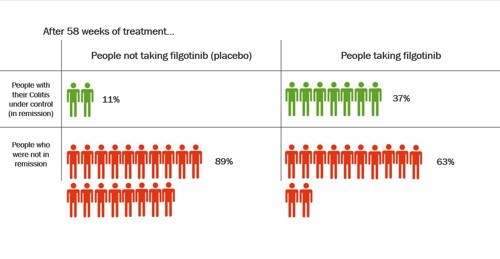
    The information below shows the results of clinical trials. These looked at how effective filgotinib is. To find this out, scientists compared people who took filgotinib with people who took a placebo. A placebo is a substance that looks the same as the treatment but does not have any medicine in it.

    After around one year of treatment with filgotinib, an average of nearly 4 in every 10 people, or 37%, were in remission. 

    Of those who took a placebo, an average of around 1 in every 10 people, or 11%, were in remission. 

    This shows that more than three times as many people had their Colitis under control after taking filgotinib for one year, compared with people taking a placebo. But filgotinib did not work well for everyone with Colitis.
    The table below shows data from clinical trials of filgotinib in adults with moderate to severely active Colitis. 
     

    Click to view at full size

    Results from other research

    One study looked at how well filgotinib worked long-term. In people who responded to filgotinib, 80% continued to be in remission after more than three and a half years. 

    Another study found that filgotnib may work better in people who have not tried biologics before.

    Filgotinib has not been compared directly with other treatments for Colitis.
    Find out more about how we talk about the effectiveness of medicines.

  • Everyone responds differently to a new medicine. If filgotinib is going to work for you, you will usually start to feel better within about 10 weeks.  Some people may take a bit longer to start to feel better. In some people, it can take up to 22 weeks, which is five to six months, to get relief from symptoms.  


    For some people, filgotinib does not help their symptoms at all. Talk to your IBD team if you are concerned that your medicine is not working. Do not stop your medicine unless you have spoken to them.

  • Filgotinib can only be prescribed by a specialist IBD team, and not your GP.  
    Filgotinib is taken as a tablet. Each tablet contains 100mg or 200mg of filgotinib.

    Getting your symptoms under control, known as induction treatment:

    • The usual dose for induction treatment for Colitis is 200mg once a day. 

    Keeping your symptoms under control, known as maintenance treatment:

    • The usual dose for maintenance treatment for Colitis is 200mg once a day.
    • Some people may have a maintenance dose of 100mg, such as if they are:
      • Aged 65 years and above, or
      • Are at higher risk of blood clots, heart attack, stroke or cancer

    If you are in a flare-up, your IBD team may increase this to 200mg once a day. 

    • If you have kidney disease, you might also need to take a lower dose. The dose in moderate to severe kidney disease is 100mg once a day.

    Try to take the tablet at a similar time each day. Swallow the tablet whole with a drink of water. You can take filgotinib with or without food. Do not split, crush or chew the tablet before swallowing. This may change how much medicine gets into your body. 

    Filgotinib tablets contain lactose. You should let your IBD team know if you have been told you have an intolerance to lactose or other sugars.

  • Your IBD team will review your treatment regularly to check whether it is still the best option for you.

  • You or your IBD team might think about permanently stopping or changing your treatment if:

    • Filgotinib has not worked. If your Colitis has not improved enough within five to six months, your IBD team may suggest you stop filgotinib and try another treatment. Your IBD team might suggest you stop filgotinib sooner if it is not working at all. 
    • Filgotinib stops working. It is possible that filgotinib may stop working for you over time. If this happens, your IBD team might suggest you stop filgotinib and try another treatment.
    • You have side effects.If you have side effects that are serious or difficult to manage, stopping filgotinib might be the best option for you.
  • Medicines for Colitis
    When you start taking filgotinib, you might continue to take: 

    It is safe to take Filgotinib with these medicines. If you need to take these medicines for another condition, let your IBD team know.

    If you are taking steroids when you start filgotinib, and respond well to filgotinib, you may be able to reduce the dose of steroids. Or you may be able to stop taking them altogether. Your IBD team will advise you about this.

    “”

    I have been taking filgotinib for over 2 years and during this time I have not been prescribed any steroids, which is a vast improvement on previous medications I have tried.

    It is important that you do not stop taking steroids or any other medicines without speaking to your IBD team.

    You should not take biologic medicines or tofacitinib if you are taking filgotinib. If you are taking other immunosuppressant medicines as well as filgotinib, your immune system may be even more affected.

    Medicines for other conditions or issues

    If you take filgotinib with other medicines that affect your immune system, you may be at increased risk of severe infection. Tell your IBD team, doctor or pharmacist if you take other medicines that affect your immune system. You may take these for other medical conditions.

    Some medicines can affect how filgotinib works. These include:

    • Some medicines to treat heart failure, coronary disease or high blood pressure, such as diltiazem or carvedilol.
    • Some medicines used to treat high cholesterol, such as fenofibrate or simvastatin.

    Speak to your IBD team, doctor, or pharmacist if you are taking, or plan to take, any other medicines while you are taking filgotinib. This includes medicines that you buy from a pharmacy or a supermarket. It also includes any herbal, complementary or alternative medicines.

  • Infection risk

    Having treatment that affects your immune system can mean that your body may not be able to fight off infections as well as it used to. Before you start filgotinib, your IBD team may ask you some questions and do some tests. This is to make sure your risk of infection is as low as possible.

    Tell your IBD team if:

    • You have an infection, or you are feeling unwell or feverish. You may need to delay your treatment if you have an infection. Also, let your IBD team know if you have often had infections in the past.
    • You have recently been in close contact with someone who has tuberculosis (TB), or been in a place where TB is common. If you may have or have had tuberculosis (TB), it will need to be treated before you start filgotinib. You will usually have a blood test and a chest X-ray to check for TB.
    • You have HIV or hepatitis. Hepatitis is inflammation of the liver. This can be caused by certain viruses. You will usually have a blood test to check for these viruses.
    • You have ever had chickenpox, shingles, cold sores or genital herpes. If necessary, you may be able to be vaccinated against chickenpox or shingles before you start treatment. At the moment, there is no vaccine for cold sores or genital herpes.
    • You have a condition or take any other medicine that weakens your immune system.
    • Your vaccinations are up to date. If they are not, your IBD team may suggest you have the ones you need. This is to help protect you from infections. Let them know if you plan to have any vaccinations or if you had a vaccination recently. If you had a live vaccine recently, you may need to wait a while before starting treatment.

    You can find out more information on how to prevent infections in our immunosuppressant precautions information.

    Cholesterol levels

    Filgotinib may increase blood cholesterol levels in some people. Before you start treatment, your IBD team will do a blood test to measure your cholesterol levels. They will measure the levels again after you have been taking filgotinib for about 12 weeks.  You may need further checks or treatment to lower your cholesterol levels.

    Blood cell levels

    Filgotinib can lower your blood levels of:

    • White blood cells. You may hear these called lymphocytes and neutrophils.
    • Red blood cells. You may hear these called haemoglobin. 

    Before you start taking filgotinib, you should have blood tests to check these. Your blood levels should be checked regularly during your treatment. Depending on the results, your IBD team may suggest you delay or stop treatment with filgotinib. You will be able to start filgotinib again when the blood levels return to what they should be.

  • When you start filgotinib, your IBD team should talk to you about how and when they will check how well it is working. Your IBD team will ask about your symptoms and any side effects that you may experience. Your IBD team will also check for any signs of infection. 

    You will have regular blood tests to check your white blood cells and red blood cells.

    It’s important that you attend your appointments and have blood checks. These help to make sure that you can carry on taking this medicine safely.

    Sometimes, different computer systems are used in hospitals compared to GP surgeries. This can mean that if you have had tests organised by your GP, your hospital team may not be able to see the results. If possible, it can help to keep your own record of any recent tests.

  • There are some things that might mean filgotinib is not right for you, or that it could have a higher risk of causing serious side effects.

    The UK Medicines and Healthcare Products Regulatory Agency provides a list of people who should take JAK inhibitors, like filgotinib, carefully. Filgotinib should only be used by the following people if no other suitable options are available:

    • People aged 65 years or over
    • People with an increased risk of having a heart attack or stroke
    • People who smoke or have smoked in the past for a long time
    • People who have an increased risk of getting cancer

    If you have any of these risk factors, your IBD team may reduce your dose. 

    Risk of heart attack or stroke

    Tofacitinib is another type of JAK inhibitor. An increase in the risk of heart attacks and stroke has been seen with tofacitinib. This risk was compared with anti-TNF medicines such as infliximab or adalimumab. Heart attacks and strokes have also been seen in some people taking filgotinib. Because of this, if you are at higher risk of a heart attack, filgotinib should only be used if no other suitable option is available. 

    Visit the NHS website to find out more about the risk factors for heart disease and stroke.


    Get urgent medical care if you have any signs of a heart attack or stroke. These can include:

    • Chest pain or tightness. This may spread to your arms, jaw, neck or back.
    • Shortness of breath.
    • Cold sweat.
    • Light headedness or sudden dizziness.
    • Weakness or numbness in the face, arms or legs.
    • Slurred speech.
    • Blurred vision.
    • Confusion.
    • Severe headache.

    Risk of cancer

    Tofacitinib is another type of JAK inhibitor. An increase in the risk of some cancers has been seen with tofacitinib. This risk was compared with anti-TNF medicines such as infliximab or adalimumab. Some cancers have also been reported in some people taking filgotinib.  If you are at higher risk of cancer, Filgotinib should only be used if no other suitable option is available.  

    Certain types of skin cancer, such as non-melanoma skin cancer, have been seen in people taking filgotinib. If you are at high risk of skin cancer, your doctor may recommend that you have regular skin checks.

    To lower your risk of skin cancer, it is a good idea to:

    • Contact your GP if you notice any changes to your skin that last for more than four weeks. This might be:
      • A lump
      • An ulcer
      • Changes in colour
      • An area of skin that looks different from the skin around it
    • Practice good sun safety. This includes:
      • Wearing a hat
      • Using high-factor sunscreen
      • Staying in the shade
      • Avoiding sunbeds

    The NHS website has more tips for staying safe in the sun.

    Blood clots

    Some medicines that work in a similar way to filgotinib have an increased risk of blood clots. These blood clots may be:

    • In the legs, known as deep vein thrombosis
    • In the lungs, known as a pulmonary embolism 

    The risk of blood clots in people taking filgotinib seems likely to be low.  The risk may be higher if you have other risk factors for blood clots. Risk factors include:

    • Older age
    • Obesity
    • Being a smoker
    • Having had a blood clot in your leg or lung in the past
    • Having major surgery
    • Not being very mobile
    • Take an oral contraceptive or Hormone Replacement Therapy (HRT)
    • Genetic conditions to do with the way your blood clots

    Find out more about the risk factors for blood clots on the NHS website.


    If you have had blood clots in your legs or lungs in the past, tell your IBD team before you start taking filgotinib. 

    Signs of blood clots can include:

    • Breathlessness.
    • Chest pain.
    • Throbbing pain. This is usually in the calf or thigh when you walk or stand.
    • Swelling in one leg, or more rarely, both legs.
    • Warm skin around the painful area.
    • Red or darkened skin around the painful area. This may be harder to see on brown or black skin.
    • Swollen veins that are hard or sore when you touch them.

    Get medical help as soon as possible if you notice any of these signs. These symptoms can also happen in your arm or tummy, if that's where the blood clot is.

  • When you start taking filgotinib, you should be given a Patient Alert Card. This is sometimes also known as a patient reminder card. You should carry this card with you. This is so that anyone treating you will know that you are taking filgotinib. If you do not have one, you can download one for printing.

    All medicines can have side effects, but not everyone experiences them. Having certain side effects might mean that filgotinib is not right for you. 

    • Some side effects can happen right away. Others may happen after you have been taking filgototinib for a while.
    • Some side effects are mild. Others may be more serious and could need treatment.
    • Some side effects may go away on their own. Others may go away after you stop taking filgotinib. Some may be long-lasting.

    Speak to your IBD team if you experience any side effects.

    “”

    I have not experienced any negative side effects and feel this medication has been the most successful for me to date. Most importantly, it has enabled me to maintain a good quality of life.

    Precautions if you are on an immunosuppressant

    Immunosuppressant medicines affect the way your immune system works. This means you may be at risk of complications associated with a weakened immune system. Our information covers some of these risks and offers practical ways to reduce your risk. It includes:

    • General hygiene
    • Food hygiene
    • Travelling abroad
    • Taking care in the sun
    • Cosmetic procedures
    • Animals

    Infections

    Filgotinib can affect your immune system. This can mean that: 

    • Your body might not fight off infections as well as other people
    • You might get more infections than you are used to
    • If you get an infection, it might last longer or be more serious than usual
    • Previous viral infections, such as shingles, may return

    Between 1 and 10 in every 100 people who take filgotinib might get: 

    • A cold,
    • A sore throat,
    • A sinus infection, or
    • A urine infection 

    Between 1 and 10 in every 1,000 people who take filgotinib might get a more serious infection, such as pneumonia or shingles.

    Talk to your doctor or get medical help straight away if you get any signs of serious infection, such as:

    • A high temperature, shortness of breath, a cough that will not go away or feeling more tired than usual. These may be signs of pneumonia.
    • A high temperature, sweating, weight loss or a cough that will not go away. These may be signs of tuberculosis (TB).
    • Needing to wee more often than usual, or a burning or stinging feeling when you wee. These may be signs of a urine infection, which can sometimes be serious.
    • A painful skin rash with blisters. This may be a sign of shingles.
      If you get an infection, your IBD team might tell you to stop taking filgotinib while the infection is treated. You should be able to start filgotinib again when the infection is under control. 

    It is usually safe to take filgotinib and antibiotics.

    Common side effects

    The most common side effects of filgotinib are listed below. These affect between 1 and 10 in every 100 people who take filgtoinib.

    • Common cold, sore throat or sinus infection.
    • Urine infection.
    • Feeling sick. This will usually go away if you keep taking filgotinib.
    • Feeling dizzy. This will usually go away if you keep taking filgotinib. If you do feel dizzy, do not drive and do not use any tools or machines.

    This is not a full list of side effects. For more information see the Patient Information Leaflet provided with your medicine or visit the electronic medicines compendium. 

    We encourage you to report any side effects to the Medicines and Healthcare Products Regulatory Agency (MHRA). You can do this: 

    This helps collect important safety information about medicines.

  • Alcohol is not known to interact with filgotinib.  But, just like everyone else, you should follow NHS guidelines. This suggests that everyone limits their weekly alcohol units to reduce general health risks.

  • Your IBD team will check that your vaccinations are up to date before you start treatment with filgotinib.

    You should not have live vaccines while taking filgotinib.

    • If you have had a live vaccine, you should wait for at least four weeks before starting filgotinib.
    • You should not have a live vaccine until at least three months after your last dose of filgotinib.

    In the UK, live vaccines include:

    • Rotavirus vaccine.
    • Measles, mumps and rubella (MMR) vaccine.
    • Nasal flu vaccine used in children. The injected flu vaccine used in adults is not live.
    • Chickenpox vaccine.
    • BCG vaccine against tuberculosis (TB).
    • Yellow fever vaccine.
    • Oral typhoid vaccine, but the injected typhoid vaccine is not live.

    If someone you live with is due to have a live vaccine, ask your IBD team if you need to take any precautions.

    The flu, pneumococcal and COVID-19 vaccines are not live vaccines. These vaccines are safe to have while taking filgotinib.

    People aged 18 years or older who take JAK inhibitors, such as filgotinib, also qualify for a non-live shingles vaccine.

  • Fertility

    Animal studies have suggested that filgotinib may affect sperm production and sperm quality. But results from a recent study in humans did not show any difference between filgotinib and a dummy treatment, known as placebo.
    There is no evidence to say whether filgotinib affects fertility in women.

    Contraception

    Your healthcare professional may advise you to take effective contraception while you take this medicine. You may also need to take effective contraception after stopping this medicine. The manufacturers recommend this should be for at least one week after stopping, while other organisations recommend three months. Our information on sex and relationships can help you decide on the right contraceptive for you.

    Pregnancy

    You should not take filgotinib if you are pregnant or are planning to become pregnant. Let your IBD team know straight away if you are taking filgotinib and you become pregnant, or you think you might be pregnant. They will be able to discuss the next steps with you.

    There is very little information about the use of filgotinib in pregnancy. But studies in animals suggest that it may cause harm to the unborn baby.

    If you are planning to get pregnant, speak with your IBD team as soon as possible. This will allow time to review your treatment options and make sure your Colitis is controlled as well as possible.

    Unplanned pregnancy

    Contact your IBD team straight away if you are on filgotinib and find out you are pregnant. If you cannot contact your IBD team, speak to your GP. Your GP may be able to help you contact your IBD team. Do not stop taking your medicine until you have spoken to your healthcare professional.

    Find out more about pregnancy and birth with Crohn’s or Colitis.

  • You should not take filgotinib if you are breastfeeding. We do not know if filgotinib passes into breast milk, or what effect it would have on breastfed babies.

    Find out more about postnatal care and breastfeeding with Crohn’s or Colitis.

  • Taking medicines and managing side effects can be difficult – we understand and we’re here to help. Our Helpline can answer general questions about treatment options and can help you find support from others with the conditions. Your IBD team are also there to help. You can talk to them about your dosage, how they’ll be monitoring you and what other options there might be. You should also get in touch with your IBD team if you have any new symptoms or side effects. It can take time to find the medicine that’s right for you. Don’t be afraid to ask questions and seek out extra support when you need it. This information is general and does not replace specific advice from your health professional. Talk to your GP or IBD team for information that’s specific to you.

  • Our Medicine Tool is a simple way to compare different medicines for Crohn’s or Colitis. You can see how medicines are taken, how well they work, and what ongoing checks you need. You can find out more on our Medicine Tool webpage.
    The Medicine Tool can help you:

    • Understand the differences between types of medicines
    • Explore different treatment options
    • Feel empowered to discuss medicine options with your IBD team

    Always talk to your IBD team before stopping or changing medicines.

  • Immunosuppressant medicines affect the way your immune system works. This means you may be at risk of complications associated with a weakened immune system. Our information covers some of these risks and offers practical ways to reduce your risk. It includes:

    • General hygiene
    • Food hygiene
    • Travelling abroad
    • Taking care in the sun
    • Cosmetic procedures
    • Animals

    Read more about precautions if you are taking an immunosuppressant.

  • We follow strict processes to make sure our information is based on up-to-date evidence and easy to understand.

    Please email us at evidence@crohnsandcolitis.org.uk if:

    • You have any comments or suggestions for improvements
    • You would like more information about the sources of evidence we use
    • You would like details of any conflicts of interest

    You can also write to us at Crohn’s & Colitis UK, 1 Bishop Square, Hatfield, AL10 9NE, or contact us through our Helpline: 0300 222 5700

Page
saved

This page has been saved in your personal space. Go to “My Page” to view all saved pages.

Helpline service

Helpline Service

We know it can be difficult to live with, or support someone living with these conditions. But you’re not alone. We provide up-to-date, evidence-based information and can support you to live well with Crohn’s or Colitis.

Our helpline team can help by:

  • Providing information about Crohn’s and Colitis.

  • Listening and talking through your situation.

  • Helping you to find support from others in the Crohn’s and Colitis community.

  • Providing details of other specialist organisations.

Please be aware we’re not medically or legally trained. We cannot provide detailed financial or benefits advice or specialist emotional support.

Please contact us via telephone, email or LiveChat - 9am to 5pm, Monday to Friday (except English bank holidays).

Live chat

If you need specific medical advice about your condition, your GP or IBD team will be best placed to help.

Stay in the loop

Together, we’re making the greatest difference. Sign up to hear about the amazing things we’re achieving together.

Privacy Policy

© Crohn's & Colitis UK

Would you like to save the changes made to this page?